You just got the news. Maybe it was a “restructuring.” Maybe it was a quiet conversation with HR that ended with a manila folder sliding across the table. Either way, you’re staring at a severance offer — and your gut tells you it’s not enough.
Here’s what I’ve learned after 15 years on the HR side of that table: the first offer is almost never the best offer. Most companies build negotiation room into their severance packages because they expect you to push back. And yet, roughly 8 out of 10 employees sign without asking a single question.
If you want to negotiate a severance package that actually reflects your value — without torching relationships you might need later — this guide lays out exactly how to do it.
Can You Actually Negotiate Severance?
Short answer: yes, in most situations, you absolutely can.
Here’s the part that surprises people. When a company offers you severance, they’re not doing you a favor. They’re buying something — specifically, your signature on a release of claims. That release says you won’t sue them for wrongful termination, discrimination, or anything else. And that signature has real monetary value to the employer.
Once you understand that dynamic, everything shifts. You stop seeing the offer as a gift and start seeing it as a transaction. Transactions, by definition, are negotiable.
I’ll be honest — there are exceptions. If you’re two months into a job and got let go for cause, your leverage is thin. But if you’ve put in years, held a specialized role, or your exit happened during a mass layoff? The company has more to lose than you think. Their legal exposure alone makes it worth their while to keep you happy on the way out.
The data backs this up. According to employment attorneys who specialize in severance, most initial offers represent the employer’s floor, not their ceiling. Employees who negotiate — even politely, even without a lawyer — consistently walk away with better outcomes.
What’s Inside a Typical Severance Package
Before you can negotiate, you need to understand what you’re negotiating. Most people fixate on the cash number and ignore everything else. That’s a mistake, because the non-monetary components can be worth just as much — sometimes more.
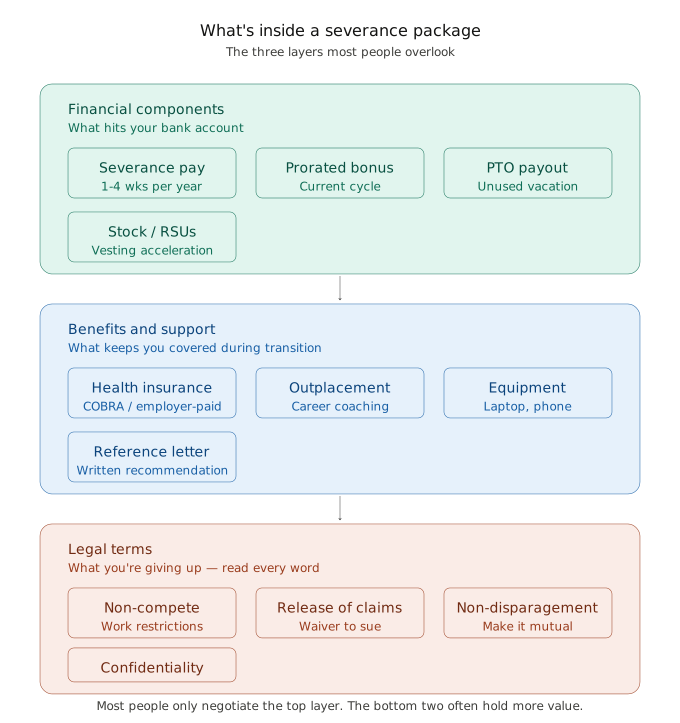
Here’s what a standard severance package might include:
Financial Components:
- Severance pay (typically 1–4 weeks per year of service, depending on the company and your seniority)
- Prorated bonus for the current period
- Payout for unused PTO or vacation days
- Stock option or RSU acceleration provisions
Benefits & Support:
- Health insurance continuation (employer-paid COBRA or equivalent)
- Outplacement services (career coaching, resume help, job search support)
- Equipment retention (laptop, phone)
Legal Terms:
- Non-compete clause (restricts where you can work next)
- Non-disparagement clause (you can’t publicly criticize the company — and ideally, they can’t criticize you either)
- Release of claims (you waive the right to sue)
- Confidentiality provisions
Here’s the thing most articles won’t tell you: the legal terms are often more negotiable than the money. Companies have rigid policies around severance pay calculations, but the non-compete language? The reference letter commitment? The exit date? Those sit in a gray zone where individual managers and HR reps have real discretion.
Pro Tip: Before your first conversation, make a two-column list. Column one: what you need most (cash runway? health coverage? freedom from a non-compete?). Column two: what you’d accept as a compromise. This clarity prevents you from negotiating reactively in the moment.
When to Negotiate — and When to Hold Back
Not every severance situation calls for a counter-offer. Knowing when to push — and when to sign gracefully — is half the strategy.
You should negotiate if:
- You’ve been with the company 3+ years. Tenure is your strongest card. A decade of service at a Fortune 500 company gives you significantly more leverage than 18 months at a startup.
- You’re in a mid-to-senior role. Directors, VPs, and senior individual contributors typically have more room than entry-level employees. The company has more invested in a clean exit.
- The termination wasn’t for performance. Layoffs, restructuring, role elimination — these are leverage-friendly contexts. The company knows you didn’t do anything wrong.
- You have institutional knowledge. If you’re the only person who understands a critical system, client relationship, or ongoing project, that’s leverage. Frame your extended presence as a transition benefit for them.
- You suspect legal issues. If the layoff disproportionately affected a protected class, or if you’ve recently filed an HR complaint, the company’s legal exposure increases — and so does your negotiating position.
Tread carefully if:
- You were terminated for documented misconduct. Severance in this case is unusual, and pushing hard could backfire.
- The company is in genuine financial distress. If they’re heading toward bankruptcy, even a generous agreement might not be honored. Consider asking for a lump sum instead of installments.
- You’re on a short fixed-term contract. Your contract likely spells out the exit terms already. There may still be room, but it’s narrower.
Even in tough situations, it rarely hurts to ask — as long as you do it professionally. I’ve seen companies offer an extra two weeks just to make the conversation go away faster.
Step-by-Step: How to Negotiate Your Severance
This is the tactical section. Follow these steps in order, and you’ll be ahead of 90% of people in the same situation.
Step 1: Don’t Sign Anything Immediately
This is non-negotiable. The moment you sign that release, your leverage drops to zero.
In the US, if you’re over 40, the Older Workers Benefit Protection Act (OWBPA) gives you 21 days to review an individual severance agreement — 45 days if you’re part of a group layoff — plus 7 days to revoke after signing. If the company doesn’t provide these timelines, the release may not be enforceable.
Even if you’re under 40 or outside the US, most companies will give you at least a week. When HR hands you the paperwork, here’s your line:
“Thank you. I’d like to take some time to review the terms carefully before signing. When is the deadline for my response?”
Professional. Reasonable. And it buys you the time you need.
Step 2: Audit the Full Package
Read every single clause. Not just the severance amount — every word. Pay special attention to:
- The non-compete scope. Does it prevent you from working in your industry for 12 months? That could cost you far more than the severance is worth. In 2024, the FTC attempted a broad non-compete ban; while enforcement has been legally contested, many states (including California, Minnesota, and Oklahoma) already prohibit most non-competes. Know your state’s rules.
- The release of claims. What exactly are you waiving? Is it specific or a blanket release?
- Mutual non-disparagement. Make sure it goes both ways. You shouldn’t be the only one restricted from speaking freely.
Step 3: Build Your Case — On Paper
Don’t walk into a negotiation running on emotion. Build a short, factual case. Include:
- Your tenure and the contributions you made during that time
- Any projects you’ll need to transition or hand off
- Market benchmarks for severance in your industry and role level
- Specific hardships the current offer doesn’t address (e.g., “My health insurance covers my family, and COBRA at full cost would be $1,400/month”)
Step 4: Make a Specific, Anchored Ask
Vague requests get vague responses. Specific requests get considered.
Don’t say: “I think I deserve more.”
Say: “Based on my seven years with the company and the standard of 2–3 weeks per year of service in our industry, I’d like to request extending the severance from 8 weeks to 16 weeks. I’d also like to discuss employer-paid COBRA for 6 months and a mutual non-disparagement clause.”
Anchor slightly above your real target. If you want 12 weeks, ask for 16. This gives both sides room to land somewhere that feels like a win.
Step 5: Negotiate Beyond Cash
If the company won’t budge on the dollar amount, pivot. Some of the most valuable things in a severance negotiation cost the company very little:
- Extended health insurance. COBRA can run $600–$1,500/month for family coverage. Employer-paid premiums for 6 months could save you $3,600–$9,000 — often more than an extra week or two of severance pay.
- Non-compete waiver or narrowing. If your offer includes a non-compete, getting it removed or limited to a specific geography is potentially worth tens of thousands in future earnings.
- A strong reference. Ask for a written recommendation or a designated reference person who will speak positively about your work.
- Extended access to outplacement services. Professional career coaching and resume support can shave months off a job search.
- A later official exit date. Even a two-week extension on your employment end date means two more weeks of insurance, 401k match, and vesting.
Step 6: Keep It Professional — Always
I cannot stress this enough. No matter how angry, hurt, or blindsided you feel — and those feelings are valid — the negotiation table is not the place to express them.
Think long-term. The HR manager you’re talking to today could be at your next company tomorrow. The hiring manager at your dream job might call your former employer for a reference. Industries are smaller than you think.
Your tone should be: grateful, direct, and solution-oriented. Not adversarial. Not emotional. Not threatening.
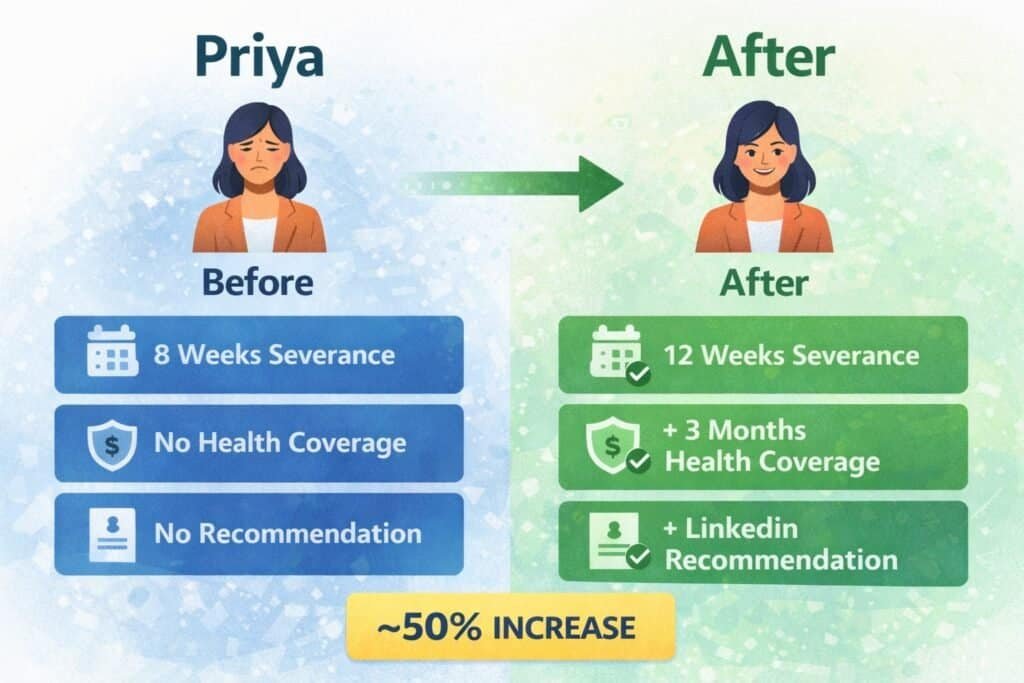
Real Scenario: From 8 Weeks to 16 Weeks
Let me walk you through something I’ve seen play out, with details changed for privacy.
Priya was a senior product manager at a mid-sized SaaS company in Bangalore — five years in, consistently strong performance reviews, led the launch of two major product lines. The company went through a restructuring, and her entire division was eliminated.
The initial offer: 8 weeks of severance (base pay only), immediate termination of health benefits, and a 12-month non-compete clause covering the entire Indian SaaS market.
Priya didn’t sign immediately. She took three days to review, then sent a professional email. Her key points:
- Her tenure and documented impact (she’d saved the company an estimated ₹2.3 crore in her last project alone)
- Industry benchmarks showing 2–3 weeks per year of service as standard for senior roles
- The non-compete was unreasonably broad — it effectively prevented her from working in her field anywhere in India
- She needed health coverage for her family during the transition
The result after two rounds of back-and-forth:
| Component | Initial Offer | Final Package |
|---|---|---|
| Severance Pay | 8 weeks | 16 weeks |
| Health Benefits | Immediate cutoff | 4 months employer-paid |
| Non-Compete | 12 months, all of India SaaS | 6 months, limited to direct competitors |
| Reference | Nothing specified | Written recommendation from VP |
| Outplacement | Not included | 3 months of career coaching |
Total estimated value improvement: roughly 80–90% over the initial offer. And she didn’t burn a single bridge. Her former VP still refers candidates to her.
The lesson? The first offer isn’t designed to be fair. It’s designed to be acceptable. Your job is to move it toward fair.
The Insider View: What HR Is Actually Thinking
Let me pull back the curtain, because this context changes how you approach the conversation.
When HR presents a severance offer, they’re working from a framework that considers three things:
- Legal risk. How likely is this employee to sue? Do they have potential claims (discrimination, retaliation, WARN Act violations)? The higher the risk, the more the company is willing to pay to make the problem go away.
- Precedent. What have we offered other employees in similar situations? Companies are terrified of inconsistency because it creates its own legal exposure. If they gave someone else in your role 12 weeks, you have a strong case for the same — or more.
- Budget flexibility. Most companies allocate a severance pool for restructuring events. The initial offer rarely uses the full allocation. There’s almost always a reserve for negotiation.
Here’s what most HR professionals won’t say out loud: we expect you to negotiate. When someone signs the first offer without a question, we’re relieved — but we also know they probably left money on the table.
The magic phrase that works almost every time: “I really appreciate the offer, and I want to make this transition as smooth as possible for both sides. Is there any flexibility on [specific item]?” It’s non-threatening, collaborative, and it gives the other person a reason to go back to their manager and advocate for you.
Common Mistakes That Kill Your Leverage
I’ve watched hundreds of severance conversations. These are the patterns that consistently lead to worse outcomes:
Mistake #1: Signing under pressure. Some companies create artificial urgency — “This offer expires Friday.” In most cases, that deadline is negotiable too. Ask for an extension. If they refuse, that itself tells you something about the organization.
Mistake #2: Getting emotional in the room. You absolutely should process your feelings — with a friend, a therapist, your partner. Not with HR. The moment you raise your voice or say “this is unfair,” you’ve shifted from negotiation to conflict. And conflict makes HR defensive.
Mistake #3: Negotiating without a specific ask. Saying “I want more” without specifying what “more” means gives the company nothing to work with. They’ll offer you an extra week and call it done. Have numbers ready.
Mistake #4: Ignoring the non-monetary terms. I’ve seen people accept an extra $5,000 in severance while leaving a crushing 18-month non-compete intact. That non-compete might cost you $50,000 or more in delayed earnings. Always read the full agreement.
Mistake #5: Badmouthing the company before the ink is dry. The fastest way to lose leverage is to post on LinkedIn about how terrible your employer is while you’re still negotiating your exit. Save the hot takes for after everything is signed and sealed.
US vs. India: Severance Rules You Need to Know
Severance negotiation looks different depending on where you work. Here’s a quick comparison for HRGet’s two largest audiences.
United States
- No federal law requires severance pay. It’s entirely discretionary unless your employment contract or union agreement says otherwise.
- WARN Act protection: If your employer has 100+ employees and lays off 50+ workers, they must give 60 days’ advance notice — or pay you for that period. Some states go further (New York requires 90 days).
- OWBPA protections for workers 40+: You get 21 days to review (45 in group layoffs) and 7 days to revoke after signing.
- COBRA: You can continue employer health insurance for up to 18 months, but you pay the full premium — which often runs $600–$1,500/month for family coverage.
- Non-competes: Enforceability varies wildly by state. California bans them almost entirely. Other states enforce them strictly.
India
- Retrenchment compensation is statutory. Under the Industrial Disputes Act, 1947 (Section 25F), “workmen” with 1+ year of continuous service are entitled to 15 days’ average pay for every completed year of service.
- Gratuity is mandatory. Under the Payment of Gratuity Act, 1972, employees with 5+ years of continuous service receive 15 days’ wages per year of service (capped at ₹20 lakh for tax exemption). The Code on Social Security, 2020 reduced this threshold to 1 year — though state-level implementation varies.
- Notice period is longer. Employers typically must provide 1–3 months’ notice (or pay in lieu), depending on establishment size and state-specific Shops and Establishments Acts.
- Non-competes are largely unenforceable. Indian courts have historically struck down post-employment non-compete clauses as restraint of trade under Section 27 of the Indian Contract Act. This gives Indian employees more freedom to negotiate these out.
- Tax treatment matters. Retrenchment compensation is exempt up to ₹5 lakh. Gratuity is exempt up to ₹20 lakh. Notice pay, however, is fully taxable. Structure your package accordingly.
Quick Comparison:
| Factor | United States | India |
|---|---|---|
| Severance legally required? | No (unless contracted) | Yes, for “workmen” under IDA |
| Typical benchmark | 1–4 weeks per year of service | 15 days per year (statutory) |
| Non-compete enforceability | Varies by state | Mostly unenforceable |
| Health benefit continuation | COBRA (18 months, self-paid) | Employer-specific; no federal mandate |
| Review period for signing | 21–45 days (if 40+) | No statutory period; negotiate it |
FAQs
Can I negotiate severance if I was laid off during a mass layoff?
Yes — and in some ways, mass layoffs give you more leverage, not less. The company faces higher legal scrutiny during large-scale reductions, especially regarding age discrimination and WARN Act compliance. If you’re over 40 or part of a protected class, the employer has extra incentive to secure a clean release. Use that to your advantage.
How much more severance can I realistically get by negotiating?
Employees who negotiate typically improve their package by 15–50%, depending on their leverage. For senior roles with long tenure, I’ve seen improvements of 80% or more. Even modest requests — an extra four weeks of pay or three months of employer-paid COBRA — can add $10,000–$25,000 to your total package value.
Will my employer withdraw the offer if I try to negotiate?
Technically, they can — but it almost never happens. Withdrawing an offer after a professional counter-proposal creates legal risk for the employer and signals bad faith. Attorneys who specialize in severance confirm that most employers anticipate some negotiation and won’t penalize you for engaging in it respectfully.
Should I hire an employment lawyer for severance negotiation?
If your severance package exceeds $25,000–$50,000 in total value, involves complex equity or deferred compensation, or includes restrictive covenants like non-competes, hiring an attorney is worth the investment. Many employment lawyers offer flat-fee severance reviews for $500–$2,000 — a fraction of what a well-negotiated package can recover.
Is severance pay taxable?
In the US, yes — severance pay is generally treated as ordinary income and subject to federal income tax, Social Security, and Medicare. In India, retrenchment compensation is exempt up to ₹5 lakh, and gratuity is exempt up to ₹20 lakh under the Income Tax Act. The tax structure of your package matters — sometimes a lump sum pushes you into a higher bracket, while salary continuation spreads the tax impact.
Can I negotiate severance before I’m even laid off?
Yes, especially at the executive level. If you’re being recruited for a senior role, negotiating severance protections as part of your initial offer letter is increasingly common in 2026. With executive tenures shrinking and boards making faster leadership changes — particularly around AI transformation roles — upfront severance agreements have become standard career infrastructure for C-suite and VP-level professionals.
What if my company says the severance is “standard” and non-negotiable?
“Standard” doesn’t mean fixed. It means that’s what they offer before anyone pushes back. Ask which specific policy document defines the standard, and whether exceptions have been made for employees in similar roles. Often, the person telling you it’s non-negotiable doesn’t have the authority to approve changes — they need to escalate to legal or a senior HR leader. That’s fine. That escalation is the negotiation working.
How long should I wait before responding to a severance offer?
Use all the time they give you — at minimum, a week. If you’re over 40 in the US, you legally have 21 days. Don’t interpret the timeline as urgency; interpret it as your window to build a strong counter-proposal. Even if you plan to accept without changes, sleeping on it for a few days ensures you’ve read every clause carefully.
Your Severance Is a Final Negotiation — Make It Count
Look, I get it. When you’ve just been let go, the last thing you want to do is sit across from HR and ask for more. It feels awkward. It feels risky. Some part of your brain is telling you to just sign the paper and move on.
But here’s what I’ve seen after watching hundreds of these conversations play out: the people who negotiate — calmly, professionally, with a clear ask — almost always come out ahead. And the people who sign on day one almost always wonder later if they should have asked.
Your ability to negotiate a severance package isn’t about being aggressive or adversarial. It’s about recognizing that this is a business conversation where both sides have something to gain from a fair outcome. You gave this company your time, your expertise, and your energy. You deserve to leave with a package that reflects that.
Take the time. Read the fine print. Make the ask. And if you need a framework for any other career decision, HRGet is built for exactly that.
Related reading on HRGet: How to Handle Being Laid Off — A Step-by-Step Guide

Eleanor Whitmore | Former Partner, Mercer | Advisor, World Economic Forum | 20+ Years in Global Compensation
Author bio: Eleanor Whitmore has spent over two decades shaping how the world’s leading organisations pay, retain, and reward talent. As a former Partner at Mercer and an advisor to World Economic Forum working groups on the Future of Work, she has designed compensation frameworks for Fortune 500 companies across the US, UK, Europe, and emerging markets. Based between London and New York, Eleanor writes for HRGet.com to translate boardroom-level pay strategy into actionable guidance for working professionals navigating real compensation decisions.