
Quick Answer
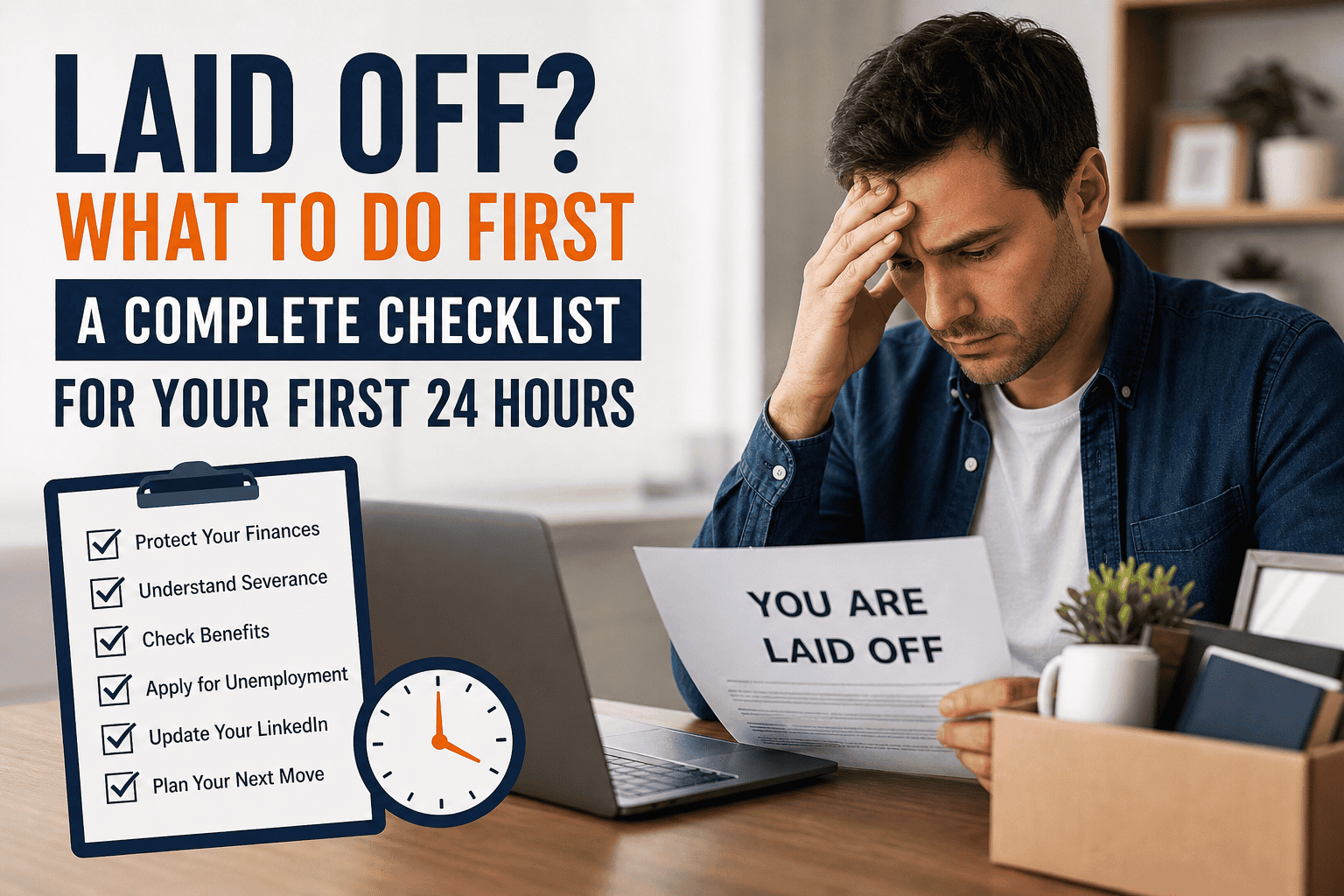
If you’ve just been laid off, your first priority is protection — not job searching. Collect key facts during the HR conversation, save your employment documents before access is removed, review the severance agreement before signing anything, clarify when health coverage ends, and begin preparing for unemployment benefits. Do all of this before updating your resume or posting on LinkedIn.
Getting laid off can feel like the floor disappeared under you. One minute you’re thinking about deadlines and performance reviews. The next, someone from HR is telling you that your role has been eliminated and that paperwork will follow shortly.
Here’s what I’ve seen after 18 years advising employees and companies through layoffs: the first 24 hours are not about finding a new job. They are about protecting your money, your legal rights, your benefits, and your financial runway.
Most people make one of two expensive mistakes. They either panic and sign everything too quickly — or they freeze and miss critical deadlines. Both choices cost real money. This checklist walks you through exactly what to do first when laid off, hour by hour, so you can move from shock to controlled action.
And if you’re outside the US — there are specific notes in this guide for UK, India, and UAE employees too, because your rights look very different depending on where you work.
The First Rule: Do Not Sign Anything Yet
If you remember nothing else from this page, remember this: do not sign your severance agreement on the same day you are laid off — not unless you’ve had adequate time to read every clause and understand what you’re agreeing to.
A severance agreement isn’t a formality. It’s a legal document that may ask you to waive discrimination claims, accept non-compete restrictions, forfeit future legal action against the company, and agree to confidentiality terms that affect what you can say about your experience. The EEOC notes that severance agreements involving waivers of discrimination claims must meet specific validity requirements — and many employees don’t know what those are when they sign.
That doesn’t mean your employer is acting in bad faith. It means you need time to read with a clear head.
Pro Tip
Ask HR one specific question before you leave the room: “What is the exact deadline to review and sign this agreement?” Write the date down on your phone or a piece of paper. Layoff conversations are emotionally charged — people forget specifics within hours. If you’re over 40, US law (the ADEA/Older Workers Benefit Protection Act) generally gives you at least 21 days to review and 7 days to revoke after signing. Ask whether those protections apply to you.
The First 30 Minutes: Collect Facts, Not Arguments
The HR conversation that ends your employment is usually short — sometimes under 10 minutes. Your goal in that room is not to debate the decision, defend your track record, or negotiate on the spot. Your goal is to gather information.
Stay calm. Take notes if you can. Ask these questions:
- Is this role elimination, or is there a performance component?
- What is my official last working day?
- When will system access be removed?
- When will I receive my final paycheck?
- Will I be paid for unused vacation or PTO?
- Is severance being offered? What is the amount and payment method?
- What happens to my bonus, commission, RSUs, or stock options?
- When does health insurance coverage end?
- Will the company provide outplacement or career transition support?
- Who is my point of contact for benefits, payroll, and documents going forward?
Real Scenario
Two mid-level managers were laid off from the same tech company on the same Tuesday morning in early 2026. The first was embarrassed, said little, signed the agreement that afternoon, and left. The second calmly asked for the signing deadline, confirmed her RSU vesting date (the cutoff was three weeks away and would have covered one more tranche), asked whether the Q1 bonus was payable given she’d completed the quarter, and got the HR contact name in writing.
Same layoff. One walked out with roughly $14,000 more in total compensation — not because she was aggressive, but because she asked.
Hour 1: Save Your Documents Before Access Is Cut
Once a layoff is announced, work system access may be removed within hours — sometimes before you’ve even left the building. Do not wait until later that day.
The ground rule: do not copy confidential company information. No client lists, no proprietary code, no internal strategy documents, no pricing data, no personnel files. That path leads to legal exposure that will follow you into your job search at the worst possible time.
But your own employment records? Those you absolutely should save.
Documents to Collect or Request
- Offer letter and any amended compensation letters
- Employment contract
- Severance agreement (to review, not sign yet)
- Separation letter
- Last three to six months of payslips
- Most recent tax forms (W-2 in the US; Form 16 in India; P60 in the UK)
- Benefits summary and health insurance details
- Bonus plan and commission plan documents
- Equity grant agreements (RSU, ESOP, stock option letters)
- PTO or leave balance statement
- Retirement account details (401k, EPF, pension)
- Non-compete, non-solicit, and confidentiality agreements you signed
- Employee handbook, if relevant to your situation
Smart Strategy
Create one folder on your personal device right now: Layoff — [Company Name] — [Month Year]. Inside it, create subfolders: Pay, Benefits, Severance, Equity, Legal, Job Search, and Taxes. When you’re stressed and fielding calls from recruiters, you will not remember where anything is. An organized document structure takes 10 minutes to create and can save you hours of chaos later.
Hour 2: Review Your Severance Package — Line by Line
Severance is not automatic in most countries. In the US, there is no federal law requiring employers to offer severance for a layoff (though company policy, employment contracts, and collective bargaining agreements may require it). In the UK, statutory redundancy pay applies after two years of service. In India, gratuity applies after five years, and severance norms vary by company and sector.
The bottom line: what’s in the package depends heavily on what you negotiate or what your contract requires. Here’s what to evaluate carefully.
1. Severance Amount and Structure
How many weeks of base salary are offered? Is it a lump sum or salary continuation? A common corporate benchmark in the US is one to two weeks per year of service, but that’s a floor — not a ceiling. Senior employees, specialized roles, sales professionals near quota, and employees with unique leverage points often do better by asking.
2. Benefits End Date
Does health coverage end on your last working day, at the end of that calendar month, or at the end of the severance period? A single day’s difference can matter if you have prescriptions, scheduled procedures, or ongoing treatment.
3. Bonus and Commission Treatment
If you completed a performance period, closed deals, or hit targets before the layoff date, ask whether those earnings will be paid. Many employees assume they won’t be — and many companies count on that assumption.
4. Equity and Stock Options
This is where mid-to-senior employees leave the most money behind. Check: your vesting cutoff date, whether unvested shares are accelerated, how long the post-termination exercise window lasts, and how equity is treated during any notice or garden leave period. A $2,000 severance “upgrade” sometimes matters far less than a single RSU tranche worth $15,000.
5. Legal Waiver Scope
The agreement may ask you to release claims against the company. The EEOC is clear that waivers involving age discrimination claims under the ADEA require specific disclosures and time windows to be legally valid. If the waiver language is broad, vague, or covers things you don’t fully understand — get a legal review before signing.
Insider View
Here’s what companies rarely advertise: they often have more flexibility on non-cash severance items than on the raw payment amount. HR may have a hard cap on severance weeks, but I’ve seen companies agree to extend health insurance for two extra months, allow employees to keep laptops, change the separation reason language (which affects unemployment eligibility), provide a formal neutral reference letter, or fund career coaching. Ask for what you actually need — not just what sounds like the biggest number.
Hour 3: Understand Your Health Insurance Options
In the US, health insurance is the most urgent practical concern for most laid-off employees — and it’s often the most misunderstood. Your employer-sponsored coverage may end the day you leave or at the end of the month. You need to know which, immediately.
The US Department of Labor explains that COBRA (Consolidated Omnibus Budget Reconciliation Act) allows eligible employees and their families to continue group health coverage after qualifying events including involuntary job loss. Coverage can last 18 to 36 months depending on the qualifying event. The trade-off: you typically pay the full group premium — the employee portion plus the employer portion — plus up to a 2% administrative fee. That can easily be $600–$1,800 per month for a family plan.
Before defaulting to COBRA, compare it against ACA marketplace plans at healthcare.gov. If your income drops significantly after the layoff, you may qualify for substantial subsidies that make marketplace coverage far cheaper than COBRA.
Immediate Questions to Ask HR Before You Leave
- On what date does health coverage end?
- Is the company subsidizing any portion of COBRA?
- When will COBRA election paperwork arrive?
- What happens to HSA or FSA funds?
- Are dental and vision still accessible under COBRA?
- Are EAP (Employee Assistance Program) mental health services still available?
UK employees: NHS coverage continues regardless of employment status. Focus instead on employer-paid private health insurance, income protection policies, and life cover that may lapse when employment ends.
India employees: Group health insurance typically ends with employment. Check whether you can port to an individual plan under IRDAI portability rules within 45 days, or purchase a new policy without a waiting period reset under a fresh employer plan.
UAE employees: Dubai and Abu Dhabi both require employers to maintain health insurance through the notice period. Confirm the end date with HR — particularly if you are in a notice or garden leave period.
Hour 4: Start the Unemployment Benefits Process Now
Many laid-off employees delay this step because it feels uncomfortable. Don’t. Unemployment insurance is not charity — you and your employer paid into the system throughout your employment precisely for this situation.
In the US, unemployment benefits are administered at the state level, and there is no single national filing process. CareerOneStop, a resource maintained by the US Department of Labor, provides a state-by-state directory for finding your state’s filing process. File as soon as you are eligible — processing backlogs are real, and your first payment date depends on when you file, not when you were laid off.
Information to Prepare Before Filing
- Social Security number (US) or equivalent tax ID
- Employer name, address, and phone number
- Dates of employment (start and end)
- Reason for separation (role elimination / layoff)
- Final paycheck information
- Severance details (states handle this differently — some reduce benefits if severance overlaps)
- Bank details for direct deposit
- Personal email and phone number
Common Mistake
Don’t assume severance payments disqualify you from unemployment. Some states offset benefits during severance periods; others treat them separately. File accurately and let the state agency determine eligibility — do not self-disqualify before even applying. Also, if you’re a contractor or gig worker who was laid off, check whether your state extended pandemic-era or updated classification rules that may now apply.
UK employees: You may be eligible for Universal Credit or New Style Jobseeker’s Allowance. Apply through gov.uk — the process is online and timing matters for retroactive benefit dates.
India employees: ESIC (Employee State Insurance) provides limited unemployment benefit (Rajiv Gandhi Shramik Kalyan Yojana) for certain insured employees. Most private sector professionals in metro cities will not qualify — focus instead on PF withdrawal rules and gratuity calculation.
Hour 5: Secure Your Personal Data Before You Lose Access
When your work account is deactivated, you may lose access to personal items you stored in work tools — contacts, calendar entries, documents, personal photos, subscriptions linked to your work email address, and two-factor authentication codes on a work device.
Again: do not copy company data. But your personal digital life is yours to protect.
Personal Items to Recover While You Can
- Personal contacts saved in a work phone or work-issued device
- Personal calendar entries or subscriptions tied to your work calendar
- Personal files accidentally stored in a work downloads folder
- Authenticator apps linked to a work device (Google Authenticator, Authy)
- Passwords saved in a work browser (Chrome, Edge)
- Personal accounts (Netflix, Spotify, bank alerts) linked to your work email
Security Steps to Take Immediately
- Change passwords for any personal accounts you accessed from a work laptop or phone
- Move subscriptions and service alerts from your work email to personal email
- Remove your work email address from banking, insurance, or government portals
- Export personal contacts from work CRM or email if permitted
- Return company property as instructed — laptops, phones, access cards, peripherals
Pro Tip
If your personal Apple ID, Google account, or password manager (1Password, Bitwarden) was ever logged into your work laptop — change those passwords from a personal device right now. This isn’t paranoia. It’s practical. Once company IT deprovisions a device, what happens to cached credentials is not always predictable. Five minutes now prevents a serious headache later.
Hour 6: Build a 30-Day Money Plan
The immediate financial goal after a layoff isn’t to rebuild wealth. It’s to buy time without making panicked decisions. One of the biggest mistakes I see is when someone accepts the first job offer they get — at a 20% pay cut — simply because they didn’t know how long their money would last.
Open a spreadsheet (or a notes app, if that’s what you have) and build a simple picture of your runway.
Income Sources to Account For
- Final paycheck (including any owed overtime or PTO payout)
- Severance payment (lump sum or monthly)
- Bonus or commission owed
- Unemployment benefits (estimate based on your state or country)
- Partner or spouse income
- Freelance or consulting work
- Liquid savings and emergency fund
Fixed Monthly Obligations
- Rent or mortgage
- Loan EMIs or student debt
- Health insurance (COBRA or replacement plan)
- Utilities and internet
- Childcare or school fees
- Minimum credit card payments
- Family financial obligations
Three Budget Modes — Pick One for Each Month
| Mode | What You Do | When to Use It |
|---|---|---|
| Normal | Maintain current spending; cancel obvious waste | Month 1 if severance + savings gives 4+ months runway |
| Defensive | Cut 25–35% of discretionary spending | Month 2–3 or if runway is 2–3 months |
| Survival | Protect only housing, food, health coverage, debt minimums, job search costs | If job search exceeds 3–4 months or runway is under 6 weeks |
Most professionals won’t hit survival mode immediately. But knowing your number — the monthly minimum you can live on — removes an enormous amount of anxiety. It’s the difference between negotiating from desperation and negotiating from a clear head.
Same Day: Update LinkedIn Without Sounding Desperate
Here’s an honest observation from years of watching layoff posts: the ones that read like a press release get the most recruiter response. The ones that read like a public therapy session generate pity — but rarely leads.
You do not need to post within hours of being laid off. Take a breath. But when you’re ready, your LinkedIn post should do three things clearly: signal you’re available, summarize your value, and make it easy for people to help you.
LinkedIn Post Template
“After [X years] at [Company], my role was impacted by a recent restructuring. I’m proud of what I accomplished — particularly [specific achievement in one sentence].
I’m now actively exploring [target role types] in [industry or function], with a focus on [key skill or domain]. If you know of opportunities or hiring managers in this space, I’d genuinely appreciate an introduction.
Thank you to the colleagues and mentors who’ve been part of this chapter.”
Before posting publicly, quietly update your LinkedIn headline to reflect open-to-work status (visible only to recruiters if you prefer). Update your “About” section summary. And check whether your most recent accomplishments are actually listed under your current role — many people’s profiles go stale during busy employment periods.
What Not to Do in the First 24 Hours
The day of a layoff is when the most irreversible mistakes happen. These aren’t hypothetical — I’ve seen each of these play out in real situations.
Mistake 1: Signing the Severance Agreement That Afternoon
You may be leaving severance pay, bonus, equity, or legal rights on the table. At minimum, sleep on it. At best, get a professional review.
Mistake 2: Posting an Angry LinkedIn Statement
Even if the company handled the layoff badly — and sometimes they do — a public anger post follows you into job interviews. Write it in your notes app if you need to process. Don’t publish it.
Mistake 3: Taking Company Files or Deleting Work Products
Do not copy confidential company data, customer lists, code, internal documents, or proprietary files. Even if you built it, the intellectual property belongs to the company under most employment agreements. This can trigger litigation at exactly the wrong time.
Mistake 4: Assuming Severance Is Fixed
Many employees assume the package is non-negotiable because HR presents it as standard. Ask anyway. The worst response is “no” — and that costs nothing.
Mistake 5: Ignoring WARN Act or Regional Layoff Rules
The US Department of Labor administers the WARN Act, which requires covered employers to provide advance notice for qualifying plant closings and mass layoffs. Not every layoff qualifies — company size, number of affected employees, and other factors matter. But if you were part of a large group reduction and received no advance notice, it’s worth verifying whether WARN applied. Back pay and benefits may be recoverable if it did.
Mistake 6: Ignoring Immigration Implications
If you are on an H-1B, L-1, OPT, Tier 2, or other work visa, your timeline after a layoff is shorter and more serious than it is for a citizen or permanent resident. Contact an immigration attorney quickly. The grace period in the US for H-1B holders is 60 days — but that window starts running from your last day of employment.
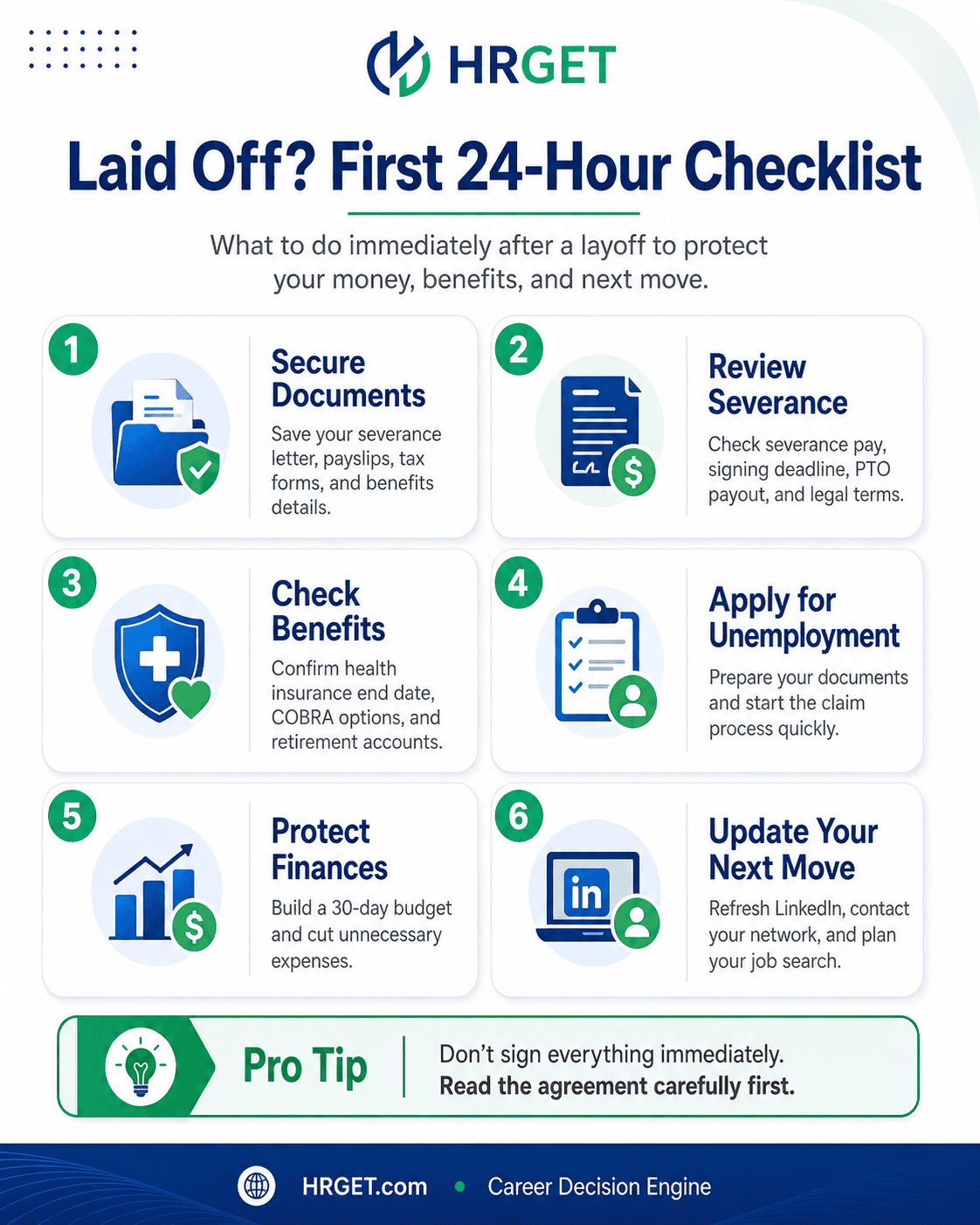
Complete First-24-Hours Layoff Checklist
Use this section as a working reference. Each block represents a time window.
First 30 Minutes — During or Right After the HR Conversation
Stay calm — don’t debate the decision in the room
Confirm: is this role elimination or performance-related?
Confirm your official last working day
Ask when system and building access will end
Ask when written separation documents will arrive
Get the signing deadline for any severance agreement
Get HR contact name for future questions
Do not sign anything immediately
First 2 Hours — Save Your Documents
Save offer letter and compensation letters
Save or request severance agreement (to review later)
Save separation letter
Save recent payslips and latest tax form
Save benefits summary and insurance details
Save equity grant letters and RSU documents
Save bonus plan and commission plan
Save unused PTO balance confirmation
Save any non-compete or confidentiality agreements you signed
First 4 Hours — Clarify Money and Benefits
Confirm final paycheck date and amount
Confirm severance amount and payment timing
Confirm unused PTO payout (if applicable)
Ask about bonus or commission eligibility
Confirm health insurance end date
Ask about COBRA and any company subsidy on premiums
Check HSA or FSA fund treatment
Check retirement account access and rollover options
Clarify immigration timeline if on a work visa
First 6 Hours — Protect Personal Data
Move subscriptions and alerts from work email to personal email
Change passwords on personal accounts accessed from work devices
Back up personal contacts
Remove work email from banking, insurance, or government portals
Transfer authenticator apps if on a work device
Return company property per instructions
Do not copy confidential company files or data
First 12 Hours — Build Your Financial Picture
Calculate cash runway: severance + savings + unemployment estimate
List all fixed monthly expenses
Cancel unnecessary subscriptions and memberships
Check state/country unemployment eligibility and begin process
Update LinkedIn headline (recruiter-visible only if preferred)
Draft — but don’t yet send — your LinkedIn post
Start a list of target roles and companies
First 24 Hours — Controlled Next Steps
Send a follow-up email to HR with unanswered questions (template below)
Review severance agreement carefully — clause by clause
Consider legal review if waiver scope is broad or equity is significant
Reach out to one or two trusted former colleagues or managers
Post (or schedule) LinkedIn announcement when ready
Create a job-search tracking spreadsheet
Block daily job-search time in your calendar
Sleep before making any major financial or legal decisions
Email Template: Follow Up With HR After a Layoff
Send this within 24 hours if questions were left unanswered during the layoff conversation.
Subject: Follow-Up — Separation Details and Next Steps
Hi [HR Contact Name],
Thank you for speaking with me today. I’m writing to confirm a few specifics so I can review everything properly before responding to next steps.
Could you please confirm the following:
- My official last working day
- Date of my final paycheck and how it will be paid
- Severance amount, payment method, and timeline
- Deadline to review and sign the severance agreement
- Date health insurance coverage ends, and COBRA election timeline
- Treatment of unused PTO or accrued leave
- Bonus, commission, or equity treatment (specifically vesting cutoff date)
- Process for returning company equipment
- Who to contact for benefits and payroll questions going forward
I appreciate your help in clarifying these points.
Best regards,
[Your Name]
How to Negotiate Severance Without Burning Bridges
Negotiating after a layoff feels uncomfortable for most people. Here’s the reframe: you’re not fighting the company. You’re asking for practical adjustments to a package that was built for the average employee — and you may not be average in the ways that matter here.
Don’t open with:
“This isn’t fair. I’ve given this company so much.”
Open with:
“I appreciate the package. Before I sign, I’d like to discuss a few practical items that are important to my situation.”
Then focus on the specific items most relevant to you:
| What You’re Asking For | Why It’s Reasonable | Common Outcome |
|---|---|---|
| Additional severance weeks | Tenure, specialized role, or limited local market | Possible at director+ levels; harder for large group reductions |
| Health insurance subsidy | COBRA costs are high; family coverage especially so | Often more flexible than cash severance increases |
| Bonus or commission payout | Completed period or closed deals before layoff | Frequently negotiable with documentation |
| RSU acceleration or extended exercise window | Layoff is close to vest date; options expire in 90 days | Requires manager or legal approval; worth asking explicitly |
| Neutral reference language in writing | Affects future employment; standard request | Usually granted at no cost to the company |
| Longer agreement review period | You need time to get legal advice | Almost always granted when requested professionally |
When You Should Speak With an Employment Lawyer
You don’t need a lawyer for every layoff. But if any of the following apply, a 60-minute consultation — which typically costs $200–$400 with an employment attorney — can be worth ten times that.
- The severance agreement includes broad legal waivers you don’t understand
- You suspect the layoff was connected to a protected characteristic (age, race, gender, disability, pregnancy)
- You recently reported harassment, safety violations, financial fraud, or illegal conduct
- You were laid off while on FMLA leave, parental leave, or a medical accommodation
- The company is pressuring you to sign immediately
- Your equity is significant (over $25,000 unvested)
- Your severance agreement contains non-compete or non-solicit clauses that affect your next role
- You’re on a work visa
- You’re an executive, department head, or senior employee with a bespoke employment agreement
- You were part of a large reduction and WARN Act notice may have been required
Warning
Do not use a general practice lawyer or a family friend who “knows some law” for employment matters. Employment law is highly specialized, varies by jurisdiction, and the timing of certain claims is short (180 to 300 days in the US under EEOC rules for discrimination claims, for example). Use a licensed employment attorney in your jurisdiction.
One More Thing: The Right Mindset for the First 24 Hours
A layoff isn’t just a professional event. It’s an identity disruption. Feeling embarrassed, angry, disoriented, or numb is not weakness — it’s a normal response to an abrupt loss of structure, income, and routine.
But don’t confuse a company’s business decision with your market value. Companies in 2026 are laying off strong, high-performing employees due to interest rate pressures, AI-driven reorganizations, investor cost mandates, and strategic pivots that have nothing to do with individual performance. The timing says nothing about your worth.
Your first 24 hours should be about one word: control. Not revenge. Not shame. Not panic-scrolling job boards at midnight. Control.
Collect your documents. Understand your money. Protect your benefits. Avoid signing anything you don’t understand. Communicate professionally with your network. And then — sleep before you make any major decisions. Seriously. The choices you make well-rested are almost always better than the ones made in the haze of the same afternoon.
Verdict
The biggest thing most people get wrong after a layoff is treating it as a career problem instead of a financial and legal one. Your first priority is protection — your severance, your benefits, your rights, and your cash runway. Job searching comes after you’ve secured those foundations. The professionals who navigate layoffs best aren’t the ones who move fastest. They’re the ones who move most deliberately in the first 24 hours.
Frequently Asked Questions
What should I do first after being laid off?
Stay calm and collect facts before anything else. Confirm your last working day, severance details, final paycheck timing, and benefits end date. Do not sign anything on the spot — ask for the review deadline. Your first hour matters more for protecting money and rights than for finding your next job.
Should I sign my severance agreement right away?
Generally, no. Severance agreements often include legal waivers, non-disparagement clauses, non-compete terms, and equity treatment language. You need time to read and understand what you are agreeing to. Ask HR for the signing deadline, write it down, and consider speaking with an employment lawyer if the package is complex or contains broad legal releases.
Can I negotiate severance after a layoff?
Yes. Severance is often negotiable, especially for senior employees, long-tenured staff, or those close to bonus dates. You can ask for additional severance pay, health insurance continuation, bonus payout, equity acceleration, extended option exercise windows, outplacement support, or a neutral reference. A calm, professional request is rarely penalized.
What happens to health insurance after a layoff?
In the US, COBRA may let you continue your employer group health plan after a job loss, typically for 18 to 36 months. The catch: you usually pay the full premium plus up to a 2% admin fee, which can be expensive. Compare COBRA against ACA marketplace plans — you may find better value, especially if your income has dropped significantly.
Should I apply for unemployment benefits immediately after being laid off?
Start the process quickly. In the US, unemployment is managed at the state level and delays affect your first payment date. You don’t have to wait until severance is resolved — prepare your SSN, employer details, separation reason, and bank information. CareerOneStop, a US Department of Labor resource, provides state-specific filing information.
What documents should I collect after being laid off?
Collect your offer letter, severance agreement, separation letter, recent payslips, tax forms, benefits summary, unused PTO balance, bonus or commission plan, equity grant documents, and any agreements you signed — non-compete, confidentiality, and IP assignment. Create a dedicated folder on your personal device before work system access is removed.
Can my employer lay me off without notice?
It depends on your location, contract, company size, and the scope of the layoff. In the US, the WARN Act requires covered employers to provide advance notice for qualifying plant closings and mass layoffs. Not every layoff triggers WARN — but if a large group was affected simultaneously with no advance notice, check whether federal or state-level requirements applied.
What should I post on LinkedIn after a layoff?
Post a calm, professional update. Mention your role was impacted, highlight key skills and your experience area, name the types of roles you’re targeting, and ask your network for leads or introductions. Avoid emotional or desperate language. Draft it, sleep on it, and post the next day — you’ll want the distance.
Next: How to Negotiate Your Severance Package
Once you know what’s on the table, here’s how to ask for more — calmly, professionally, and with the right leverage points.

Michael Reeves | Former Senior Counsel, Littler Mendelson | Severance & Restructuring Specialist | 18+ Years in Employment Law
Author bio: Michael Reeves spent nearly two decades as Senior Counsel at Littler Mendelson — one of the world’s largest employment law firms — advising on mass layoffs, corporate restructurings, and severance negotiations for Fortune 500 companies across the US and Europe. He has worked both sides of the table: structuring cost-efficient separation packages for employers and, more recently, helping employees understand exactly where their leverage lies. Based between Chicago and London, Michael writes for HRGet.com to demystify the legal and financial dimensions of layoffs — so employees stop leaving money on the table.