

By Jonathan Reed — Executive Career Strategist & Leadership Advisor (Former Partner, McKinsey & Company) | 18+ years advising senior leaders at Amazon, Unilever, and FTSE 100 companies
Executive presence is one of those career phrases people throw around when they cannot clearly explain why one person gets promoted and another does not. You may have heard feedback like: “You need to show more executive presence” — and walked away with absolutely no idea what to change.
That is frustrating, because the feedback sounds important but vague. It feels like someone is saying “Be more senior” without telling you what to actually do differently.
Here’s the truth: executive presence is not about having a deep voice, wearing expensive clothes, using corporate jargon, or dominating every meeting. It is the ability to make people trust your judgment, follow your thinking, and feel confident that you can handle bigger responsibility.
That matters whether you are a manager, senior individual contributor, HR professional, founder, consultant, or someone simply trying to move into a leadership role. If your work is strong but your career growth has slowed, executive presence may be the missing layer between “good performer” and “trusted leader.”
In this article, I’ll break down exactly what executive presence means in practice, what it looks like in real workplace situations, and how to build it — deliberately — starting this week.
What Is Executive Presence?
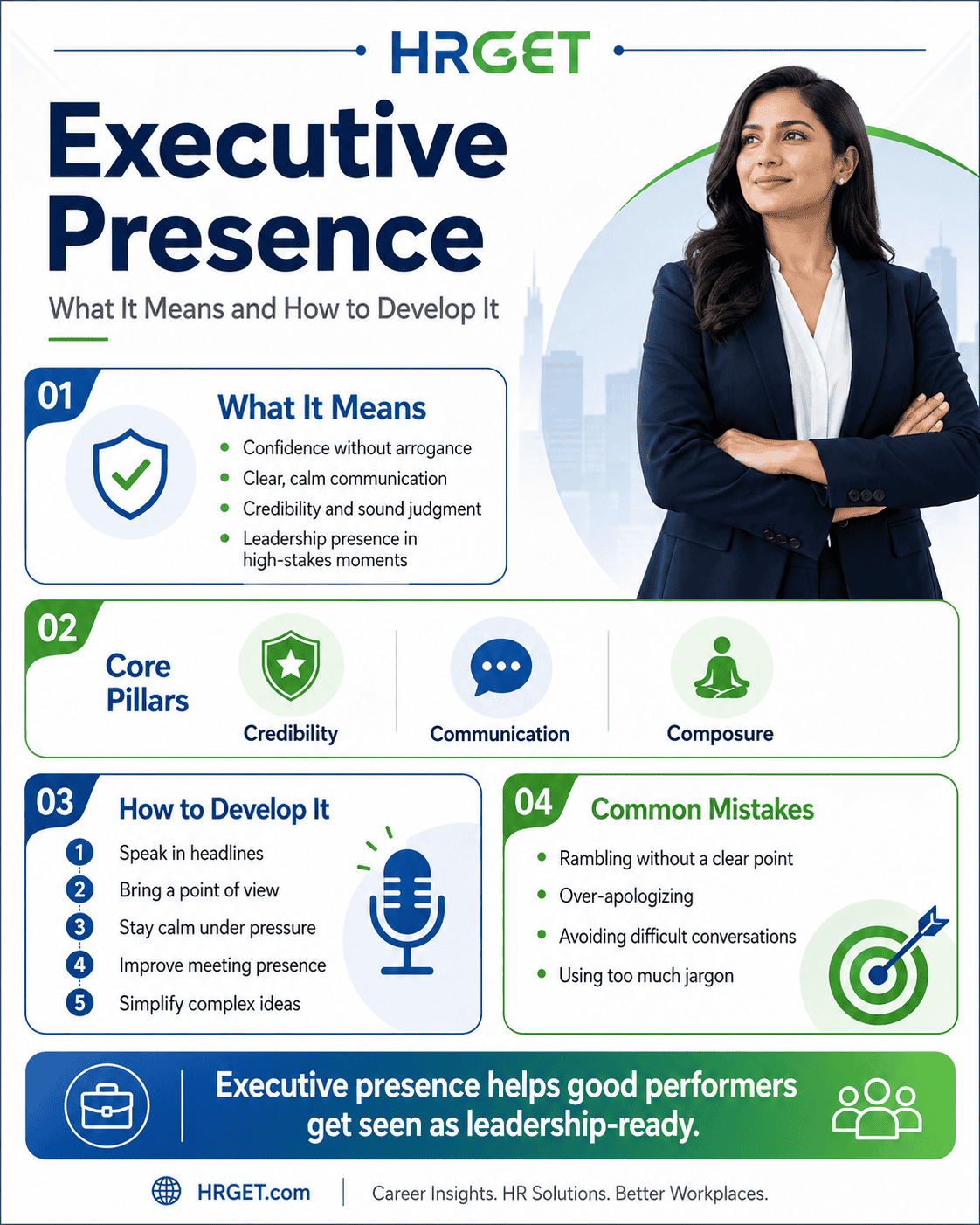
Executive presence is the ability to project confidence, credibility, clarity, and calm judgment in professional situations. It is how people experience you when the stakes are high.
Do they trust you with complex problems? Do they listen when you speak? Do they feel you bring clarity to a room, rather than confusion?
It is not only about personality. Introverts can have strong executive presence. Quiet people can have it. Technical experts can develop it. New managers can build it. The real test is simple:
The Executive Presence Test
When you walk into a difficult conversation, do people feel more confident after hearing you? If yes, you are building executive presence. If no, you may still be seen as capable — just not yet as leadership-ready.
Sylvia Ann Hewlett, whose research for the Center for Talent Innovation mapped executive presence across senior leaders at Fortune 500 companies, identified three primary components: gravitas, communication, and appearance. In 2026, the “appearance” dimension has evolved significantly — especially for remote and hybrid workers — but gravitas and communication remain central to how senior leaders are evaluated everywhere from Mumbai to Manhattan.
Why Executive Presence Matters for Career Growth
Executive presence matters because promotions are not based only on output. That may sound unfair, but it is true — and I have seen it play out hundreds of times across industries.
At junior levels, career growth depends heavily on execution: Can you complete tasks? Can you deliver quality work? Can you meet deadlines? At senior levels, the expectations change entirely. Leaders start asking questions that have nothing to do with task completion:
- Can this person handle ambiguity without needing constant direction?
- Can they influence stakeholders without formal authority?
- Can they communicate confidently with the executive team?
- Can they stay calm when the customer escalates or the plan falls apart?
- Can they simplify complexity and drive a room toward a decision?
This is where executive presence becomes the determining factor. You may be technically brilliant, hardworking, and deeply reliable. But if senior leaders do not trust you in high-stakes rooms, your career will hit a ceiling — regardless of how good your output is.
Companies value executive presence because senior roles involve risk. A leader is not just doing work. A leader is making decisions, shaping direction, influencing people, managing conflict, and communicating trade-offs upward and downward. Someone with executive presence reduces that uncertainty. They make others think: “This person has control of the situation. They understand the bigger picture. They can be trusted with more.”
That perception directly impacts promotions, salary growth, and whether you get invited into the rooms where real decisions happen.
The Three Core Pillars of Executive Presence
Executive presence has many definitions, but in practical workplace terms — across every industry and region I have worked in — it comes down to three things:
| Pillar | What It Means | What It Looks Like When Missing |
|---|---|---|
| Credibility | People trust your judgment and reasoning, not just your output | You raise concerns without structure; you wait to be told what to think |
| Communication | You make complex situations clear, structured, and audience-appropriate | You over-explain details; you bury the headline; you ramble under pressure |
| Composure | You respond with control in difficult moments rather than reacting emotionally | You become defensive when challenged; you panic visibly; you shrink in conflict |
Credibility: People Trust Your Judgment
Credibility is the foundation. And most people misunderstand where it comes from. They assume it comes from being the smartest person in the room. It does not.
Credibility comes from being reliable, thoughtful, and clear. You build it when you prepare before important discussions, explain trade-offs without oversimplifying them, admit what you do not know, follow through on every commitment, and bring insights rather than just opinions.
Credibility in Practice
Weak: “I think this project is risky. We should probably delay it.”
Strong: “There are three risks with launching next month: a hiring dependency, customer support readiness, and an open compliance review. My recommendation is to launch the low-risk feature set now and move the compliance-heavy items to phase two.”
The second person is not just raising a concern. They are demonstrating judgment. That is executive presence.
Communication: You Make Complex Things Clear
Communication is the most visible part of executive presence — and the most commonly misunderstood. Many capable professionals believe that showing every detail proves competence. But senior leaders rarely want every detail first. They want the point.
A person with strong executive communication can explain the same issue differently to a CEO, a technical team, an HR leader, a client, and a junior employee — adjusting the level of detail and framing to what each audience actually needs. They reduce cognitive load for others rather than adding to it.
A simple structure that works across almost every high-stakes communication: What is the issue? → Why does it matter? → What are the options? → What do you recommend? → What decision is needed? Lead with the headline. Follow with the context.
Composure: You Stay Calm Under Pressure
Composure is what people notice when things go wrong. Anyone can sound polished when the project is on track. Executive presence becomes visible when deadlines slip, a customer escalates, or leadership challenges your thinking directly.
People with strong executive presence may feel pressure internally, but they respond with control. They pause. They listen. They clarify before reacting. They make decisions based on facts rather than emotion.
Composure does not mean becoming cold or robotic. You can be passionate and emotionally direct. But when your emotional reaction becomes bigger than the business problem, people start doubting your readiness for senior responsibility. The goal is not to suppress emotion — it is to channel it productively.
How to Develop Executive Presence at Work
The good news: executive presence can be built. Some people pick it up early through exposure and coaching. Most professionals develop it through deliberate, specific practice. Here are the habits that move the needle fastest.
1. Start Thinking Beyond Your Task List
If you want to be seen as leadership-ready, stop communicating only at task level. Task-level updates — “I completed the report,” “The dashboard is ready,” “We fixed the issue” — are fine, but they do not signal executive presence. They signal execution, which is necessary but not sufficient.
Before every important update or meeting, ask yourself five questions: Why does this matter? Who is affected? What decision is needed? What risk should leaders know? What is my recommendation? This single habit can immediately change how senior people perceive your potential.
2. Lead With the Headline
One of the fastest ways to sound more senior is to lead with the most important point, then explain how you got there. Many professionals do the opposite — they build up context first and bury the headline at the end. By the time they reach the point, the listener has mentally checked out.
Use this structure consistently: Headline → Context → Options → Recommendation → Ask.
Pro Tip
Example in practice: “Revenue hiring is behind plan. The main reason is offer decline rate, not sourcing volume. We have two options: increase compensation flexibility or reduce role requirements. My recommendation is to adjust compensation bands for priority roles. I need approval from finance by Friday.” — That is executive communication in five sentences.
3. Pause Before Responding
Many professionals damage their executive presence by reacting too quickly. When challenged, they immediately defend. When questioned, they over-explain. When criticized, they go quiet or go tense. A deliberate pause — even two seconds — signals control rather than reactivity.
Try these phrases when you are under pressure: “That’s a fair question. Let me separate the data from the assumption.” Or: “I don’t have that number right now, but I can share the decision logic.” These responses buy you time and simultaneously communicate calm authority.
4. Build a Clear Point of View
People with executive presence are not passive messengers. They do not simply report what happened. They interpret what it means and make a recommendation. Many professionals avoid taking positions because they fear being wrong. At senior levels, that caution backfires — leaders expect you to have a reasoned stance, not to sit on the fence.
You can still be balanced: “My recommendation is option A because it delivers faster impact with lower operational risk. The trade-off is that we will need to revisit scalability next quarter.” That is far stronger than “both options have pros and cons.”
5. Strengthen Your Meeting Presence
Meetings are where executive presence is most visibly judged. You do not need to speak constantly — in fact, speaking too much without adding value is one of the most common mistakes. When you do speak, your contribution should move the conversation forward.
Before any important meeting, ask: What is the purpose of this meeting? What decision or alignment is needed? What will I contribute? What questions may come up? During the meeting, look for moments to clarify confusion, summarize trade-offs, or help the room move toward a decision. After the meeting, a crisp follow-up — “Three decisions from today, two open risks, and the next owner for each action” — strengthens your reputation quietly but powerfully.
6. Handle Pushback Without Becoming Defensive
This is one of the most important executive presence tests, and one of the hardest. When senior leaders challenge your idea, they are often testing the robustness of your thinking — not attacking you personally. If you become defensive, you signal that you are not yet ready.
A better approach is to respond with curiosity and control: “I see the concern. The trade-off I considered was…” or “I agree with part of that. Where I see it differently is…” or “That changes the assumption. In that case, I would adjust the plan.” These responses show you can hold a position without being rigid — which is exactly what senior leadership looks like.
7. Simplify Complexity for Your Audience
Senior leaders are overloaded with information. If you can turn complexity into clarity, you become genuinely valuable. Instead of presenting a pile of details, bring meaning. The compensation issue is not spread across departments — it is concentrated in two locations among senior technical roles. Broad salary correction is not needed; targeted retention action is. Find the signal inside the noise. That is a skill that gets noticed and rewarded at every level.
Common Mistakes That Damage Executive Presence
Sometimes executive presence is not built by adding new behaviors. It is built by removing the habits that quietly erode trust. Here are the five most common.
Speaking too much without saying enough. Visibility and executive presence are not the same thing. Talking in every meeting, repeating points, adding commentary when no decision is needed — these create fatigue, not presence. Speak less often, but with more structure and more value.
Overusing corporate jargon. Words like “synergy,” “strategic unlock,” and “cross-functional enablement” are not executive presence. They are noise. Simple language almost always sounds more confident than dense jargon. If someone has to work to understand you, you are not being clear — you are being complicated.
Avoiding difficult conversations. You cannot build a leadership reputation if you sidestep tension. Senior leaders are expected to address performance gaps, missed deadlines, stakeholder disagreement, and promotion readiness directly. Avoidance may feel safe in the short term, but it is career-limiting over time.
Being too casual in high-stakes moments. Being personable is an asset. Being careless in a serious discussion about layoffs, legal risk, or executive decision-making is not. Executive presence includes judgment about context and tone — the same approach that works in a team social will look immature in a board review.
Over-apologizing. “Sorry, just a quick point.” “Sorry, maybe I’m wrong.” This language weakens your presence before you have even said anything meaningful. Replace unnecessary apologies with confident language: “Let me add one point.” “My view is slightly different.” You can be respectful without shrinking your voice.
Real Scenario: Two Employees, Same Work, Different Perception
Real Scenario
Imagine two employees — Aisha and Rohan — both strong performers who worked on the same project and know the details equally well. In a leadership review, they are both asked: “What is the current status, and what should we do next?”
Aisha says:
“We completed most of the work. There are a few pending items from the operations team, and we are following up. We should be able to close soon.”
Rohan says:
“We are 80% complete, but the launch date is at risk because operations has not confirmed staffing coverage. There are two paths: launch with limited support next week, or delay by two weeks for full readiness. My recommendation is a limited launch — customer impact is low and we can monitor closely.”
Same project. Same facts. Completely different perception. Rohan gives status, risk, options, recommendation, and decision logic. Aisha gives a progress summary. Leaders will remember Rohan as the one ready for more responsibility — even though both did exactly the same work.
Executive Presence for Remote and Hybrid Workers
Executive presence is harder to build in remote and hybrid environments because fewer people observe you naturally. In an office, your composure during a tough meeting, your energy in a hallway conversation, your body language in a presentation — all of these are visible without any effort on your part. In a remote setting, none of that happens automatically. You need intentional visibility.
Remote workers often make the mistake of assuming good work will speak for itself. It usually does not. Your work needs translation. That does not mean self-promotion — it means helping leaders understand the impact, not just the output.
- Send crisp, structured updates that show business thinking, not just task completion
- Use video when discussions are important — audio-only meetings reduce your visible presence significantly
- Follow up meetings with decisions and action owners, not just notes
- Volunteer for visible problem-solving work that crosses teams
- Build relationships beyond your immediate team so your reputation travels
The professionals who build the strongest executive presence in distributed environments are the ones who communicate with the same deliberateness in a Slack message as they would in a boardroom. Every written update is an opportunity to show judgment, not just effort.
How to Know If You Already Have Executive Presence
You may already have executive presence if people consistently do these things without being asked: seek your opinion before making decisions, trust you with sensitive conversations, invite you to senior-level discussions, give you cross-functional projects, ask you to represent the team, or describe you as someone who “always stays calm.” These are the organic signals that your presence is already registering with people above you.
If none of those things are happening yet, that is useful information too. It means your work may be strong, but your presence has not yet caught up to your potential. The gap is closeable — and faster than most people expect when you focus on the right behaviors deliberately.
Building Executive Presence Is a Skill, Not a Personality Trait
Here is what I want you to take from this: executive presence is not something you are born with. It is not reserved for extroverts, for people who went to elite institutions, or for those with thirty years of seniority. It is a skill set — one that can be observed, learned, and practiced in the everyday moments of your career.
The most powerful place to start is the next meeting you walk into. Lead with the headline. Come prepared with a point of view. Pause before responding to a challenge. Follow up with clarity. Do these things consistently, and the perception of you will start to shift — not because you changed who you are, but because you changed how you show up.
That is what executive presence actually means. And that is entirely within your reach.
📈If you are actively working toward a promotion, read our in-depth guide on how to get promoted at work — including the specific conversations to have with your manager and the timing mistakes that cost people the opportunity.
Frequently Asked Questions About Executive Presence
Can introverts develop executive presence?
Yes — and in some cases, introverts develop stronger executive presence than extroverts. Presence is not about volume or energy. It is about credibility, clarity, and composure. Introverts who prepare thoroughly, speak with structure, and stay calm under pressure often earn more trust than those who simply fill the room with noise. Executive presence is a skill, not a personality type.
How long does it take to develop executive presence?
With deliberate practice, noticeable changes in how others perceive you can happen within 4–8 weeks. Simple habits — leading with the headline, pausing before responding, following up meetings with clear summaries — shift perception quickly. Full credibility as a leader takes longer, typically 6–18 months of consistent behavior. The key is that specific, practiced habits compound far faster than waiting for experience alone.
What is the difference between executive presence and confidence?
Confidence is an internal state. Executive presence is how that state — or the appearance of it — is perceived externally. Someone can be highly confident and still have weak executive presence if they ramble, avoid taking positions, or react emotionally under pressure. Conversely, you can build visible executive presence through practiced behaviors even on days when you do not feel fully confident internally.
How do you build executive presence in virtual or remote meetings?
In virtual settings, presence comes from communication quality, not physical visibility. Use video when discussions are important, structure your contributions around a clear headline and recommendation, follow up meetings with decisions and action owners, and avoid multitasking on calls. Written updates are also a major presence-builder remotely — a crisp message that shows business judgment is noticed at every level of leadership.
Is executive presence more important in the US, India, or other markets?
The core pillars — credibility, communication, composure — matter everywhere. The expression differs by culture. In US and UK workplaces, directness and confident recommendations are expected early. In Indian corporate environments, especially MNCs, the same qualities matter but may be expressed with more deference to hierarchy. In UAE markets, relationship credibility often precedes communication credibility. Understand the cultural context, but do not let it become an excuse to avoid developing presence.
Can executive presence be faked?
Short-term impression management is possible, but it does not hold up. Credibility, in particular, cannot be sustained through performance alone — it requires actual preparation, follow-through, and sound judgment over time. What looks like “faking it” in the short term is more accurately described as deliberately practicing behaviors before they feel natural. That is not deception; it is how every professional skill develops.
How do I ask my manager for feedback on my executive presence?
Ask specific, behaviorally-focused questions rather than vague ones. Instead of “Do I have executive presence?”, try: “In the last leadership meeting, was my communication clear and structured enough? Did I give a strong enough recommendation?” or “When I present to senior leadership, where do I lose the room?” Specific questions get specific answers — and show the self-awareness that is itself a marker of executive presence.

Jonathan Reed: Executive Career Strategist & Leadership Advisor | Former Partner, McKinsey & Company | Executive Coach to Amazon & Unilever Leaders | 18+ Years in Career Strategy
Jonathan Reed spent nearly two decades as a Partner at McKinsey & Company, where he advised organisations on leadership development, talent strategy, and organisational design across the US, UK, and Asia. Since leaving consulting, he has worked as an executive coach to senior leaders at Amazon, Unilever, and a clutch of high-growth scale-ups — helping them navigate promotions, career pivots, and the unwritten rules of visibility and influence at the top. Based between London and New York, Jonathan writes for HRGet.com to give working professionals an honest look at how careers actually scale — and why so many talented people stall without ever knowing why.