
Updated: April 2026 · 12 min read
If you’re searching for how to file an HR complaint against your manager, something has already gone wrong — and you’re right to take it seriously. Over 15 years studying workplace dynamics and advising professionals through toxic situations, I’ve seen one pattern repeat itself constantly: employees either act too late, or act without strategy. Both outcomes hurt them.
The truth most articles won’t tell you? HR is not your advocate. HR exists to protect the company. That’s not cynicism — that’s organizational reality. But it doesn’t mean you’re powerless. It means you need to go in prepared, documented, and clear-headed. This guide gives you exactly that.
What Qualifies as an HR Complaint?
Not every difficult manager warrants an HR complaint — and conflating workplace frustration with genuine misconduct will undermine your credibility when it really matters. I’ve sat in on enough HR investigations to know that the complaints that get taken seriously share one thing: they’re grounded in policy violations, not personality clashes.
Here’s a clear breakdown of what does and doesn’t cross the threshold:
| Valid HR Complaint | Usually Not HR Territory |
|---|---|
| Sexual, verbal, or physical harassment | Manager has a harsh communication style |
| Discrimination based on gender, race, religion, age, disability, national origin | Being left off an invitation to an optional team lunch |
| Retaliation after you raised a concern | Receiving constructive performance feedback |
| Hostile work environment (legally defined — repeated, severe, pervasive) | One uncomfortable conversation |
| Ethical violations or illegal activity (wage theft, falsifying records) | Disagreeing with how a project was handled |
| Coercion or threats related to employment | Not getting the project you wanted |
This distinction matters because HR triage is real. Complaints that look like interpersonal friction get deprioritized. Complaints that look like legal liability get investigated immediately. Frame yours in the right category from the start.
⚠ Important Note:
In the US, the Equal Employment Opportunity Commission (EEOC) defines a hostile work environment as conduct that is severe or pervasive enough to create an intimidating, hostile, or offensive work environment — not just unpleasant interactions. In India, the POSH Act (2013) governs sexual harassment complaints specifically. In the UK, the Equality Act 2010 covers harassment linked to protected characteristics. Knowing which legal framework applies to your situation significantly strengthens your complaint.
When to File — Timing Matters More Than You Think
Timing is the most underestimated element of an HR complaint. File too early — before you have documentation — and your complaint looks impulsive. Wait too long — after months of documented incidents — and HR will wonder why you tolerated it, which subtly shifts responsibility onto you.
The ideal window is after a pattern has formed but before lasting harm is done. Here’s how to read that moment:
File now if:
- The behaviour is repeated (three or more incidents) and getting worse
- You’ve already tried informal resolution and it hasn’t worked
- Your physical or mental health is being affected — sleep disruption, anxiety, dread of going to work
- There’s a paper trail: emails, messages, witnesses
- The issue involves potential illegality (discrimination, harassment, wage violations)
Wait and document if:
- It was a one-time incident without a clear policy violation
- You have no documentation yet — filing on memory alone rarely works
- You’re still in your probationary period and want more context on company culture first
💡 Pro Tip:
HR processes are evidence-driven, not emotion-driven. The single most effective thing you can do before filing is build a timestamped written record. Keep it in a personal document outside company systems — not in Google Workspace or your work email, which your employer may access.
Step-by-Step: How to File an HR Complaint Against Your Manager
This is the exact process that works inside real organisations — not a generic checklist. Each step builds on the previous one, so don’t skip ahead.
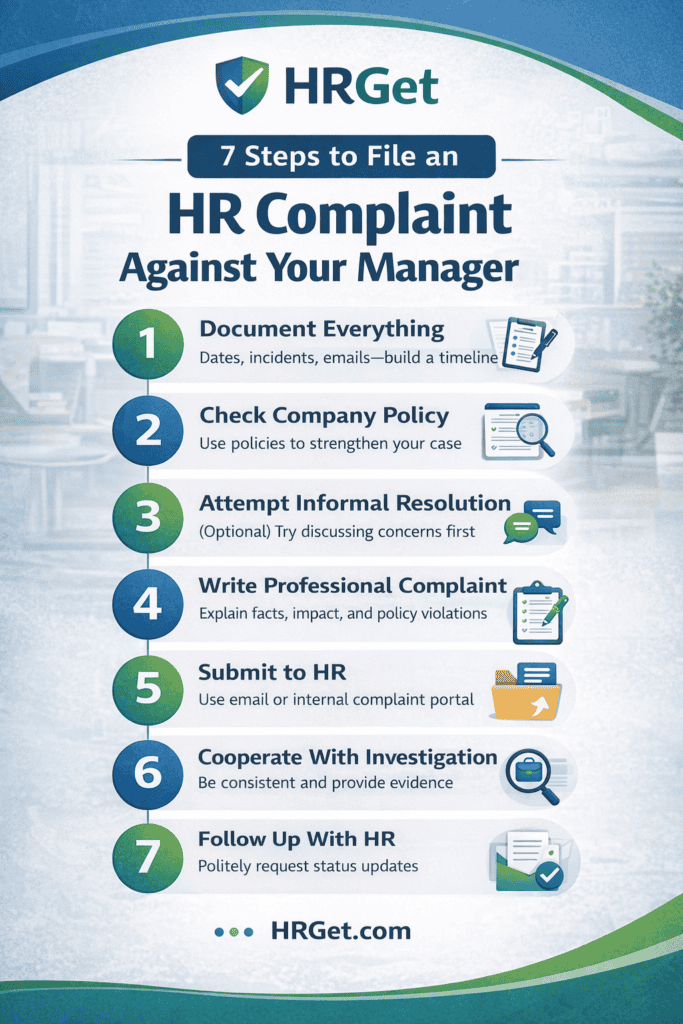
- 1Build Your Documentation — Before Anything Else
- 2Review Your Company’s Complaint Policy
- 3Consider Informal Resolution First — When Safe
- 4Draft Your Written Complaint — Professionally and Specifically
- 5Submit Through the Correct Channel — and Keep a Copy
- 6Cooperate With the Investigation — Consistently
- 7Follow Up — Professionally and Persistently
Real Scenario: What Actually Happens After You Complain
📋 Real Scenario:
Situation: A senior analyst at a mid-sized financial services firm in London filed a formal complaint against her line manager for consistently undermining her in client-facing meetings and excluding her from project briefings that directly affected her work.
She had three months of email evidence showing she had been deliberately left off distribution lists and had a witness — a peer who’d noticed the pattern. She submitted a structured written complaint referencing the firm’s dignity at work policy.
What happened: HR acknowledged receipt within 48 hours. An investigation was opened. The manager was interviewed and denied intent. The peer corroborated her account. Outcome: the manager received a formal written warning and mandatory coaching. She was moved to a different team lead for her next project cycle — at her request, which HR agreed to.
Key takeaway: The complaint worked because it was specific, documented, policy-referenced, and included a clear requested outcome. She didn’t ask HR to “fix her manager” — she asked for a concrete and reasonable resolution.
Smart Strategy: Protect Yourself Before Filing
Here’s what experienced professionals do that most people in this situation don’t. The moment you decide you may need to file a complaint, start these protective steps in parallel — before you submit anything.
1. Move sensitive communications to personal channels. Conduct any conversations with trusted colleagues or advisors from your personal email or phone. Assume your work accounts can be accessed by your employer at any time.
2. Audit your own performance record. Pull any recent performance reviews, emails where you’ve received positive feedback, or project records that demonstrate strong performance. Retaliation often arrives dressed as performance management — your counter-evidence needs to be ready in advance.
3. Update your LinkedIn and resume quietly. This isn’t pessimism. It’s pragmatism. Even if the complaint goes perfectly, the working relationship with that manager is unlikely to recover. Having options makes you less psychologically dependent on the outcome of the investigation.
4. Identify allies, not recruits. Know which colleagues have observed the behaviour. You don’t need to recruit them before filing — but knowing who can corroborate your account is valuable. Don’t pressure anyone to take sides.
5. Understand your legal rights before you file. In the US, Title VII of the Civil Rights Act and the NLRA protect workers who make good-faith complaints from retaliation. In the UK, the Employment Rights Act 1996 provides whistleblower and grievance protections. In India, the Industrial Disputes Act and POSH Act provide specific channels. Knowing your rights changes how you engage with the process.
Common Mistakes That Kill Complaints
I’ve seen legitimate complaints fail because of avoidable errors. These are the most common ones:
| Mistake | Why It Hurts You | What to Do Instead |
|---|---|---|
| Filing without documentation | HR cannot act on verbal accounts alone — they need a defensible paper trail | Build your incident log for at least 2–3 weeks before filing |
| Using emotional or accusatory language | Makes the complaint look personal rather than policy-based; HR shifts focus to your credibility | Stick to facts: dates, words, witnesses, impact |
| Venting to colleagues before filing | Gives your manager advance warning; reduces witness impartiality | Keep your intentions confidential until submitted |
| Expecting rapid resolution | Leads to frustration and pressure tactics that make you look difficult | Set a realistic 4–6 week mental timeline; follow up politely at 10 days |
| Not requesting a specific outcome | HR won’t know what “success” looks like for you; complaints without requests are harder to resolve | State clearly: investigation, mediation, transfer, or a specific corrective action |
The Insider View: What HR Will and Won’t Do
🔍 Insider View:
This is the part most articles skip, and it’s the most important thing I can tell you: HR’s primary obligation is to the organisation, not to you. That sounds harsh. It’s not. It’s how the function is designed.
What this means in practice: HR will investigate your complaint thoroughly if it represents legal or reputational risk to the company. They will act if the evidence is solid. They will take the complaint seriously if you’ve followed process correctly. But they are not in the business of punishing managers just because an employee is unhappy.
The complaints that get results are the ones where the employee has: (1) documented specific policy or legal violations, (2) submitted a professional, factual complaint, and (3) requested a clear, reasonable resolution. When those three elements are in place, HR’s interests and yours actually align — because a well-documented complaint gives HR a clear path to action that protects the company from further liability.
What HR will do:
- Acknowledge receipt and open an investigation (if your complaint is substantive)
- Conduct interviews with you, your manager, and named witnesses
- Review emails, messages, and any system logs relevant to your complaint
- Document their findings and determine whether a policy violation occurred
- Take remedial action if a violation is confirmed — ranging from coaching to termination depending on severity
What HR won’t do:
- Automatically take your side because you filed first
- Remove a manager without substantiated evidence
- Keep your identity confidential in all circumstances — investigations usually require disclosure
- Act as your therapist or emotional support — that’s not their role
- Guarantee that the working relationship with your manager will be recoverable
What If HR Doesn’t Help?
Sometimes investigations conclude without the outcome you hoped for. That doesn’t mean you’re out of options — it means you need to escalate or pivot deliberately.
Step 1: Escalate internally. If your HR department fails to investigate or you believe the process was compromised, escalate to senior leadership — a CEO, COO, or board-level HR executive — or use your company’s ethics hotline if one exists. Frame your escalation as a concern about process integrity, not a replay of your original complaint.
Step 2: Document any retaliation. If you experience adverse employment action (demotion, exclusion, poor performance reviews that weren’t warranted before your complaint) after filing, document it immediately. Retaliation is illegal in the US under Title VII and in the UK under the Employment Rights Act 1996. This documentation forms the foundation of a secondary, stronger complaint — and potentially a legal claim.
Step 3: Engage external channels. In the US, you can file a charge with the EEOC if your complaint involves discrimination or harassment — there is a 180-day (or 300-day in some states) statute of limitations from the date of the last incident. In the UK, employment tribunals can hear grievances that were not resolved internally. In India, the ICC (Internal Complaints Committee) under POSH handles unresolved sexual harassment matters. Consulting an employment lawyer before taking this step is strongly advisable.
Step 4: Evaluate your exit strategy. This is the advice most career advisors avoid because it feels defeatist. It isn’t. If the environment is deeply toxic, your manager has leadership protection, and internal resolution has failed — staying and fighting may cost you more than leaving strategically. Document your achievements, secure references while they’re still available, and plan your transition. Leaving on your own terms is not losing. It’s prioritising your career over a battle you may not be able to win from inside.
💡 Pro Tip — The “Outcome Test”:
Before deciding whether to escalate externally or exit, run this test: If this complaint is resolved exactly as I hope — what does my working life look like one year from now? If the honest answer is “still uncomfortable, still watched, still affected by what happened” — then winning the complaint may not be worth what it costs you to get there. Sometimes the strategic move is extracting yourself cleanly rather than winning a battle that leaves you isolated.
Frequently Asked Questions
Most companies accept anonymous complaints, but they’re significantly harder to investigate. HR cannot interview you for clarification, corroborate your account, or keep you updated on outcomes. Anonymous complaints work best for reporting observed misconduct involving others — not for personal grievances where you’re seeking a specific resolution. If your primary concern is retaliation, it’s better to file formally and request that HR keep your identity confidential during initial stages of the investigation.
Legally, no — terminating an employee for filing a good-faith complaint is retaliation, which is prohibited under Title VII (US), the Employment Rights Act 1996 (UK), and equivalent legislation in India and the UAE. Practically, retaliation can happen in subtler forms: reduced responsibilities, exclusion from projects, or a sudden negative performance review. Document any changes in your employment conditions that occur after filing. That documentation becomes your evidence if you need to escalate.
For straightforward complaints (single incident, clear evidence, few witnesses), investigations typically conclude within 2–3 weeks. Complex complaints — those involving multiple incidents, several witnesses, or potential legal liability — can take 4–8 weeks. In large organisations or highly unionised environments, the timeline can stretch to 12 weeks. Your company’s grievance policy should specify a response timeline; if they miss it, you have grounds to escalate on procedural grounds.
In most cases, no. Once your manager knows a complaint is coming, they have time to shape the narrative, brief their own allies, and potentially find procedural grounds to discredit your account. The exception: if company policy requires you to raise the matter with your direct manager first (some formal grievance processes do), document that conversation in writing immediately afterward and proceed to HR within 24–48 hours.
This is where your documentation is decisive. If your incident log is timestamped, specific, and corroborated by at least one witness, your manager’s denial carries less weight — HR investigators are experienced at identifying inconsistencies between accounts. Stay consistent with your documented record during your interview. Avoid getting drawn into speculation about your manager’s motivations; focus on what was said and done, when, and in front of whom.
In the US, “HR complaint” and “grievance” are often used interchangeably for informal and formal concerns. In the UK, a “formal grievance” has a specific legal meaning under the ACAS Code of Practice — it triggers a mandatory response process and protects your right to be accompanied by a colleague or trade union representative in any hearings. Knowing which framework applies in your jurisdiction affects how you should frame and submit your complaint.
Yes — and they usually have to, in order to conduct a fair investigation. Your manager will typically be informed of the general nature of the complaint (though not always every specific detail) and given an opportunity to respond. This is why confidentiality before filing matters so much. If you’re concerned about specific details being shared, you can request that HR exercise discretion about what is disclosed and at what stage — but you cannot prevent disclosure entirely in most jurisdictions.
Before You File — Read This First
Filing an HR complaint against your manager is a serious step that deserves serious preparation. The professionals who navigate this well are the ones who go in with documented evidence, a professional complaint, and a realistic sense of what HR can and cannot do.
If you’re dealing with a broader workplace conflict — including a manager who’s targeting you more subtly — our guide on how to deal with a toxic boss covers the patterns to watch for and the strategies that actually work before you reach the complaint stage.
The Bottom Line
Filing an HR complaint against your manager is not just a procedural act — it’s a career decision that requires strategy. I’ve seen professionals come out of this process with resolved situations, restored dignity, and stronger workplace standing. I’ve also seen people file poorly-prepared complaints that damaged their own credibility and left them in a worse position than before.
The difference, almost always, comes down to preparation: specific documentation, a professional complaint, a realistic understanding of what HR will and won’t do, and a parallel plan to protect yourself regardless of the outcome.
You have every right to file an HR complaint against your manager when that manager is engaging in conduct that is genuinely harmful or illegal. Exercise that right — but exercise it strategically.

Organizational Psychologist & Workplace Behavior Advisor (Former consultant with Boston Consulting Group, research contributor aligned with Harvard Business Review)
Dr. Amelia Grant is an organizational psychologist specializing in burnout, toxic workplaces, leadership behavior, and employee mental resilience. She writes practical, research-backed workplace guidance for modern professionals.