
Most people who fail at switching careers don’t fail because they lack talent or drive. They fail because they picked the wrong certification — something that looked credible on a LinkedIn profile but meant absolutely nothing to the hiring manager reviewing their résumé. I’ve spent 18 years coaching executives and mid-career professionals through some of the most high-stakes transitions I’ve ever seen. And the pattern is consistent: the people who successfully change careers in 2026 aren’t the ones who collected the most certifications. They’re the ones who chose strategically.
This guide cuts through the noise. Below, you’ll find the best certifications for career change organized by industry — not by what’s popular on social media, but by what’s actually generating job offers right now.
Why Certifications Work for Career Switchers
Here’s the blunt truth most career advice glosses over: when you’re switching industries, your years of experience in your old field are largely invisible to a new hiring manager. Your decade in finance doesn’t automatically transfer credibility when you’re applying for a product management role.
Certifications solve a specific problem. They give hiring managers a shortcut — a trusted third-party signal that says “this person has baseline competency in this domain.” That’s it. That’s all they do. But in a world where recruiters spend an average of six seconds on a résumé before deciding whether to read on, that signal matters enormously.
For professionals aged 25–40 — which is exactly who I work with most — certifications also tend to deliver better ROI per dollar than going back for another degree. A PMP certification costs roughly $400–$600 in exam fees and a few hundred more in prep materials. An MBA from a mid-tier school costs $80,000 and two years. If your target role doesn’t require the MBA prestige signal, the certification wins almost every time.
🎯 Insider View:
When I advise executives making lateral or downward career pivots, I always tell them: the certification isn’t for your skills — you probably already have the skills. It’s for the ATS and the recruiter who doesn’t know you yet. Think of it as a translation layer between your old career and your new one.
How to Choose the Right Certification (Before You Spend a Cent)
This is the step most people skip, and it’s the one that separates career-changers who land jobs from those who just collect digital badges.
Step 1: Search LinkedIn Jobs first, courses second. Go to LinkedIn, filter for your target role and city, and read 20–30 job descriptions. Note what certifications appear in the “preferred qualifications” section. If a certification shows up in fewer than 5 of those listings, it’s a signal — not a requirement.
Step 2: Check if the credential is issuer-recognized. There’s a meaningful difference between a Google Career Certificate and a random Udemy completion badge. Recognized issuers in 2026 include: Google, AWS, Microsoft, PMI, SHRM, CFA Institute, AAPC, CompTIA, HubSpot, and Salesforce. If it’s not from a name like these, it needs to be paired with a portfolio to carry any weight.
Step 3: Audit the proximity of your pivot. The most successful career transitions are adjacent, not radical. The further you’re jumping, the longer the runway you need.
| Your Background | Target Field | Pivot Type | Cert Alone Sufficient? |
|---|---|---|---|
| Finance Analyst | Data Analytics | Adjacent | Yes |
| Operations Manager | Project Management | Adjacent | Yes |
| Sales Rep | Digital Marketing | Adjacent | Yes |
| Admin/HR Coordinator | HRIS/People Ops | Adjacent | Yes |
| Teacher | UX Design | Moderate | Cert + Portfolio |
| Teacher | Cybersecurity | Steep | No — needs bootcamp |
Best Certifications for Career Change 2026 — By Industry
I’ve organized these by field, with honest commentary on what actually moves the needle for career switchers versus what looks good in a course catalogue but doesn’t translate at the interview stage.
Tech & IT — Highest Salary Ceiling, Fastest Entry
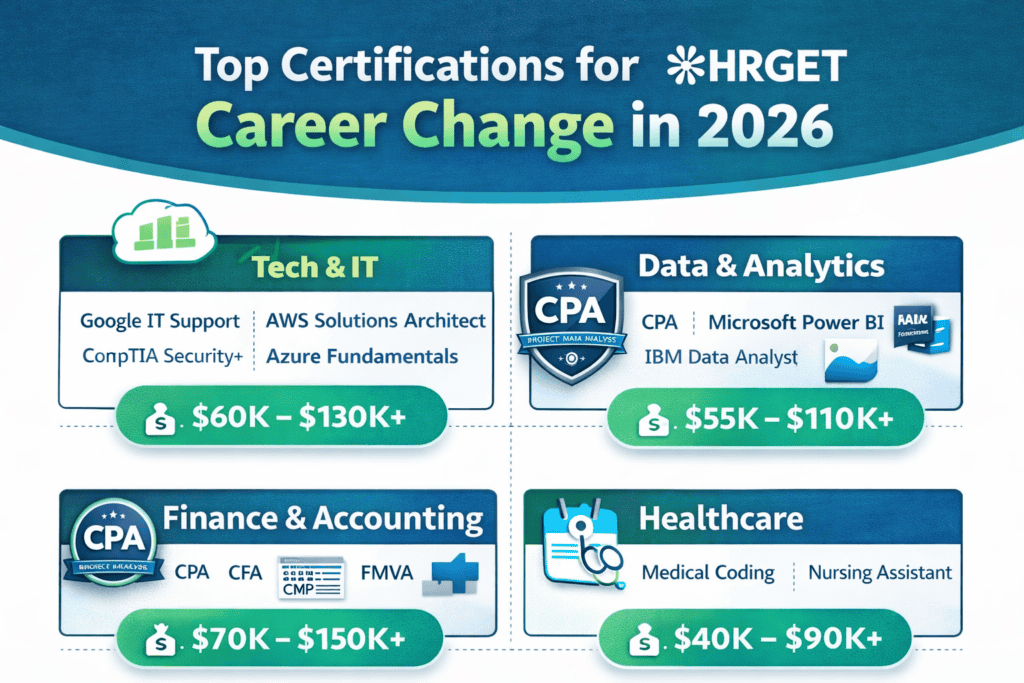
Top certifications: Google IT Support Professional Certificate, CompTIA A+, AWS Certified Solutions Architect – Associate, Microsoft Azure Fundamentals (AZ-900), CompTIA Security+
If you’re starting from zero tech background, the Google IT Support Certificate (available on Coursera, roughly 3–6 months) is the clearest on-ramp. It’s designed for non-technical career switchers, and Google actively partners with employers who give it preferential consideration.
Once you’re in a support or helpdesk role, the next logical step is cloud. AWS and Azure are not interchangeable for your job search — check your target companies’ tech stacks. AWS dominates US startups and mid-market; Azure is stronger in enterprise and UK/EU public sector.
💡 Pro Tip:
Don’t try to learn both AWS and Azure simultaneously. Pick one based on where the jobs are in your city, get certified, get the role, then expand. Trying to cover both from the start is how people end up 12 months in with two half-certifications and no job offers.
Data & Analytics — Best for Analytical Thinkers
Top certifications: Google Data Analytics Professional Certificate, Microsoft Power BI Data Analyst (PL-300), IBM Data Analyst Professional Certificate, Tableau Desktop Specialist
Data roles are the most accessible “tech-adjacent” path for professionals from finance, operations, HR, or marketing backgrounds. You don’t need to be a software engineer. You need to be comfortable with structured thinking and willing to learn SQL and Excel at an intermediate level.
Here’s something most guides won’t say plainly: Power BI proficiency alone — not even a full certification, just demonstrated skill — is landing mid-career professionals data analyst interviews at $65K–$80K roles right now. Add the PL-300 certification, and you have a credible signal for larger enterprises.
🎯 Insider View:
I’ve reviewed hundreds of data analyst résumés over the years. The ones that get callbacks aren’t necessarily the most certified — they’re the ones that show a project. A Power BI dashboard built on real (or simulated) business data, published on GitHub or a personal site, does more work than any certificate badge. Build while you learn.
Finance & Accounting — High Trust, Long Runway
Top certifications: CFA (Chartered Financial Analyst), CPA (Certified Public Accountant), FMVA (Financial Modeling & Valuation Analyst), ACCA (global recognition)
Finance certifications carry the highest trust signals of any industry — but they also carry the longest timelines. The CFA program alone requires passing three exams over a minimum of two to three years, with an average pass rate below 45% per level. It’s genuinely hard, and that’s partly why it’s valuable.
If you need to move faster — say, you’re pivoting from operations or consulting into a corporate finance role within the next 12 months — the FMVA from CFI is the most underrated certification in this category. It’s recognized by major investment banks and corporate finance teams, covers financial modelling at a practical level, and takes 3–6 months to complete. I’ve seen professionals from non-finance backgrounds land FP&A roles at $90K–$105K off the strength of an FMVA plus demonstrated Excel and modelling work.
Healthcare — Recession-Proof, Consistently Understaffed
Top certifications: Certified Nursing Assistant (CNA), Medical Coding (CPC via AAPC), Health Informatics Certificate, Pharmacy Technician Certification
Healthcare is the most recession-proof switch on this list — demand is structural, not cyclical. But the roles within healthcare vary enormously. If you don’t want clinical work, the smart path for a career-switcher is health informatics or medical coding. Both are desk-based, leverage existing computer literacy, and don’t require a clinical background.
The CPC certification from AAPC takes roughly 4–6 months of focused study and opens doors to medical coding roles paying $45K–$65K remotely — a field where experienced coders are genuinely hard to find in 2026.
Project Management — The Universal Career Bridge
Top certifications: PMP (Project Management Professional), Certified Scrum Master (CSM), PRINCE2 (UK and Europe), PMI-ACP (Agile)
Project management is the most industry-agnostic certification category on this list. A PMP holder is employable in construction, software, healthcare, government, finance — virtually everywhere. That’s also why it’s one of the highest-ROI certifications for mid-career professionals who’ve managed projects informally but never been titled as a PM.
The catch: PMP requires 36 months of project management experience (or 60 months without a four-year degree) before you can sit the exam. If you don’t have that experience on paper, start with the CSM (Certified Scrum Master) — it has no prerequisites, takes a two-day course plus an exam, and gets you into Agile PM roles at tech companies paying $70K–$95K as a stepping stone to PMP eligibility.
Digital Marketing — Best Remote & Freelance Optionality
Top certifications: Google Digital Marketing & E-commerce Certificate, HubSpot Content Marketing Certification, Meta Blueprint Certification, Semrush SEO Toolkit Course
Digital marketing has the lowest formal barrier to entry of any field on this list — and that’s both its strength and its weakness. Because anyone can get a Google Digital Marketing certificate in a few weeks, the certificate alone won’t differentiate you. What differentiates you is a demonstrable portfolio: a blog you’ve grown, a brand account you’ve managed, an e-commerce campaign you’ve run, even for a nonprofit or a personal project.
Treat certifications here as table stakes, not differentiators. The HubSpot certifications are free and respected. The Google certificate gives you structured fundamentals. But neither will get you hired without evidence of execution.
HR & People Operations — Overlooked but High-Demand
Top certifications: SHRM-CP / SHRM-SCP, PHR / SPHR (HRCI), People Analytics Certificate (AIHR or Wharton Online), aPHR (Associate — no experience required)
If you’re in operations, admin, finance, or even teaching and want to pivot toward HR, the aPHR from HRCI is purpose-built for career switchers — it’s the only HR certification with no work experience prerequisite. It costs around $300 in exam fees and signals genuine HR fundamentals knowledge to hiring managers.
For those already in adjacent roles or with some HR exposure, the SHRM-CP is the gold standard in the US and carries strong international recognition. Companies that run structured HR departments typically list SHRM-CP as a preferred qualifier for HR Business Partner and HRBP roles paying $80K–$110K.
Certification ROI: Quick Comparison Table
| Certification | Time to Complete | Approx. Cost (USD) | Salary Impact | Best For |
|---|---|---|---|---|
| Google IT Support | 3–6 months | $200–$300 | $50K–$75K entry | No-tech background |
| AWS Solutions Architect | 3–5 months | $300 exam | $95K–$130K | Tech-adjacent switchers |
| Power BI (PL-300) | 2–4 months | $165 exam | $65K–$100K | Finance/Ops → Data |
| PMP | 3–6 months (+ experience req.) | $405–$555 | $95K–$140K | Mid-career PMs |
| FMVA (CFI) | 3–6 months | $497–$997 | $80K–$110K | Non-finance → FP&A |
| SHRM-CP | 3–5 months | $300–$500 | $70K–$110K | Operations → HR |
| CPC (Medical Coding) | 4–6 months | $300–$500 | $45K–$65K remote | Admin → Healthcare |
| Google Digital Marketing | 6–8 weeks | $200–$300 | $50K–$80K entry | Sales/Comms → Marketing |
Real Scenario: The Two Approaches — and Which One Gets Hired
📋 Real Scenario:
Marcus, 34, ex-Operations Manager at a logistics company: Decided to pivot into data analytics after his division was restructured. He enrolled in four certifications simultaneously — Google Data Analytics, IBM Data Science, Tableau, and a Python course — spending 9 months and nearly $2,000. He didn’t build a single end-to-end project. His applications got no traction.
Priya, 31, ex-HR Coordinator: Wanted the same data pivot. She spent 3 months on the Google Data Analytics Certificate, built two dashboards using publicly available HR data sets (one analyzing attrition trends, one analyzing compensation equity), and posted them to GitHub. She framed every cover letter around her domain expertise in HR data. She had three interviews within six weeks of applying and accepted a People Analytics Analyst role at $78,000.
The difference wasn’t the certification. It was the proof.
Smart Strategy: How to Execute a Career Change in 90 Days
This is the part most certification guides skip entirely — the actual execution plan. Here’s what a focused 90-day transition looks like:
Days 1–15: Decide and validate. Pick one target role (not one target industry — a specific role, like “Data Analyst at a mid-size SaaS company”). Search 30 job descriptions. List the skills and certifications that appear most frequently. That’s your roadmap.
Days 16–60: Learn and build simultaneously. Don’t finish the course before you start building. Start your first project by week three, even if it’s rough. The practice of building accelerates learning faster than any amount of passive watching.
Days 61–75: Position yourself publicly. Update your LinkedIn headline to reflect your target role, not your current one. Add the certification to your profile the day you complete it. Start connecting with people already in your target role — not asking for jobs, just for 15-minute conversations. This is the single most underused lever in career transitions.
Days 76–90: Apply aggressively and iterate fast. Apply to 50+ roles. Track your response rates by résumé version. If you’re getting under a 10% callback rate after 30 applications, something in your résumé framing is off — adjust before you keep applying.
💡 Pro Tip:
The fastest career transitions I’ve seen — often 60–90 days — happen when the professional targets companies where their old industry expertise is actually an asset in their new role. A nurse who pivots into health tech sales. A teacher who moves into corporate L&D. An accountant who shifts to finance software implementation. Your background isn’t irrelevant — reframe it as a differentiator.
Common Mistakes That Kill Career Pivots
I’ve watched talented people fail at career switches that should have worked. Almost always, it traces back to one of these:
Certification hoarding. Doing four certifications to feel productive while avoiding the scarier work of applying and potentially getting rejected. One certification executed well beats four certifications with no evidence of application.
Switching to saturated fields without a differentiation angle. Digital marketing and UX design are both high-demand fields — and both are flooded with career-switchers right now. You need a narrative: why you, specifically, with your specific background, in this specific role. Generic applications in saturated fields go nowhere.
Targeting roles too far from your experience base. The 2–3 year runway required for radical pivots is real. If you’re a teacher wanting to break into cybersecurity, a single certification won’t bridge that gap — you need a structured bootcamp, mentorship, and probably a starting salary reset. Knowing this upfront saves 12 months of frustration.
Not updating the story on LinkedIn while you’re learning. Most recruiters find passive candidates on LinkedIn before those candidates ever apply. If your LinkedIn still says “5th Grade Teacher” while you’re studying for your CompTIA Security+, you’re invisible to the market. Update as you go.
Expecting certifications to replace networking. In a career change, the cold application funnel is brutal. Even a single internal referral dramatically increases your odds of an interview. Invest time in building relationships in your target industry while you’re still learning.
Frequently Asked Questions
For the broadest applicability, the PMP leads for mid-career professionals with project experience. For those starting from scratch, the Google IT Support Certificate or Google Data Analytics Certificate offer the fastest time-to-hire at the lowest cost. The FMVA is the most underrated for finance-adjacent pivots.
In tech, data analytics, digital marketing, project management, and HR — yes, in most cases. Regulated fields like medicine, law, and engineering still require accredited degrees. The key is knowing whether your target roles list degrees as “required” or “preferred” in job postings — the latter is typically negotiable with the right certifications and demonstrated experience.
For adjacent pivots with a focused strategy: 3–6 months. For moderate pivots with some skills gap: 6–12 months. For steep pivots requiring foundational learning: 12–24 months. These timelines assume active application, networking, and project-building — not just studying. Passive learners typically double these timelines.
It depends on the issuer. Free certifications from Google, HubSpot, Meta, and Salesforce carry genuine weight — these companies have established employer recognition programs. Free certificates from generic e-learning platforms without issuer brand recognition are essentially invisible to recruiters. Pair any free certificate with demonstrated project work to compensate.
Digital marketing and IT support are consistently the fastest fields for certification-led pivots — many professionals land their first role within 60–90 days if they combine the certification with portfolio work and active networking. Medical coding is also surprisingly fast for remote work, given persistent demand and a 4–6 month certification timeline.
Both. Start applying in your target field before you finish your certification — even if it’s just informational conversations and exploratory applications. Waiting until you’re “fully ready” costs you market intelligence, networking momentum, and often 3–6 unnecessary months. You can complete your certification while interviewing. Many hiring managers respect candidates actively in-progress.
One, done well. The data consistently shows that professionals who focus on one targeted certification and build demonstrable proof of application outperform those who accumulate multiple certifications without projects or practical experience. The exception is highly technical fields like cybersecurity, where a stack of credentials (CompTIA A+ → Network+ → Security+) represents a recognized progression.
The Bottom Line on Career Change Certifications
The best certifications for career change in 2026 aren’t the most popular ones — they’re the ones that align with real hiring demand in your target role, bridge the credibility gap from your specific background, and can be paired with demonstrable proof of skill within 90 days.
Stop researching and start executing. Pick one certification, build one project, make one application. That loop — repeated 50 times — is how careers actually change.
Related reading: How to Change Careers at 30, 35, or 40 Without Starting Over →

Jonathan Reed: Executive Career Strategist & Leadership Advisor | Former Partner, McKinsey & Company | Executive Coach to Amazon & Unilever Leaders | 18+ Years in Career Strategy
Jonathan Reed spent nearly two decades as a Partner at McKinsey & Company, where he advised organisations on leadership development, talent strategy, and organisational design across the US, UK, and Asia. Since leaving consulting, he has worked as an executive coach to senior leaders at Amazon, Unilever, and a clutch of high-growth scale-ups — helping them navigate promotions, career pivots, and the unwritten rules of visibility and influence at the top. Based between London and New York, Jonathan writes for HRGet.com to give working professionals an honest look at how careers actually scale — and why so many talented people stall without ever knowing why.