

To change careers effectively: first diagnose whether the problem is your job, company, or actual career path. Then identify an adjacent field where your transferable skills still count, close the skill gaps with targeted proof projects, reposition your resume around your new direction, and test the market while still employed. Most successful career transitions take 3–12 months. The biggest mistake is quitting before you’ve validated the new path.
Here’s the honest truth that most career change articles won’t open with: the fact that you’re searching for how to change careers already puts you ahead of most professionals who spend years quietly tolerating a path they’ve outgrown.
You might have a stable job, a respectable title, and a salary that looks fine on paper. But if Sunday evenings feel heavy, if you’ve stopped imagining the senior version of yourself in this field, and if the last time work genuinely energised you was years ago — you’re not experiencing a bad week. You’re experiencing misalignment.
I’ve spent 18 years advising executives and mid-career professionals on career transitions, including at McKinsey, Amazon, and Unilever. The professionals who change careers successfully aren’t the bravest or the most impulsive. They’re the ones who treat the transition like a strategy problem — diagnosing the real issue first, reducing risk methodically, and building their bridge before they burn anything down.
This guide gives you a complete, step-by-step career change plan — built for professionals who want to move thoughtfully, not desperately.
Why Career Change Feels So Difficult
Career change feels harder than it should because it attacks three things simultaneously: your identity, your income, and your confidence. You’re not just changing a job title. You may be changing how people introduce you at dinner parties, how you explain yourself on LinkedIn, and how you measure professional progress for the next decade.
A software engineer moving into product management worries about losing their technical credibility. A secondary school teacher pivoting into corporate L&D worries about being taken seriously in business settings. A finance analyst moving into people analytics worries about being labelled a beginner after years of seniority. These fears aren’t irrational — they reflect real trade-offs that deserve honest evaluation.
Here’s what I’ve observed repeatedly: the professionals who stay stuck longest aren’t those who lack courage. They’re those who frame the decision as binary — “stay forever or blow everything up.” The smarter frame is this: what is the lowest-risk path from my current career to a better-fitting one?
That reframe changes everything. Suddenly it’s not a leap off a cliff. It’s a series of small, deliberate steps across a bridge you’re building while still employed.
Insider View
Hiring managers don’t fear career changers as much as career changers fear themselves. What they actually fear is hiring someone who made the move impulsively — without researching the field, building relevant skills, or being able to articulate a coherent reason. Show deliberateness, and the non-linear background becomes an asset, not a liability.
Signs You Actually Need a Career Change (Not Just a Job Change)
Not every miserable Monday means you need a new career. Sometimes you need a better manager, a healthier culture, or simply a few weeks off after an exhausting sprint. The distinction matters enormously — because the wrong diagnosis leads to an expensive wrong solution.
A job problem sounds like: “I like the work, but this company is political, slow, and my manager takes credit for my output.” A career problem sounds like: “Even at a better company with a reasonable boss, I’d still dread the nature of this work.”
Some clearer signals that a career change — not just an employer switch — may be what you need:
- You feel disengaged consistently, even after changing teams or companies.
- You’ve lost interest in becoming senior in your current field.
- Your industry has genuine structural headwinds — shrinking demand, wage stagnation, or automation exposure.
- Your core strengths aren’t being used in any realistic version of your current role.
- You admire professionals in adjacent fields more than the leaders ahead of you in your own.
- You’re staying only because of inertia, fear, or financial pressure — not because you want to.
The test I give executives: if your company called tomorrow and offered you a promotion to the next level in your current field — same company, better pay, more scope — would that genuinely excite you, or would it feel like a trap? Your gut answer is diagnostic.
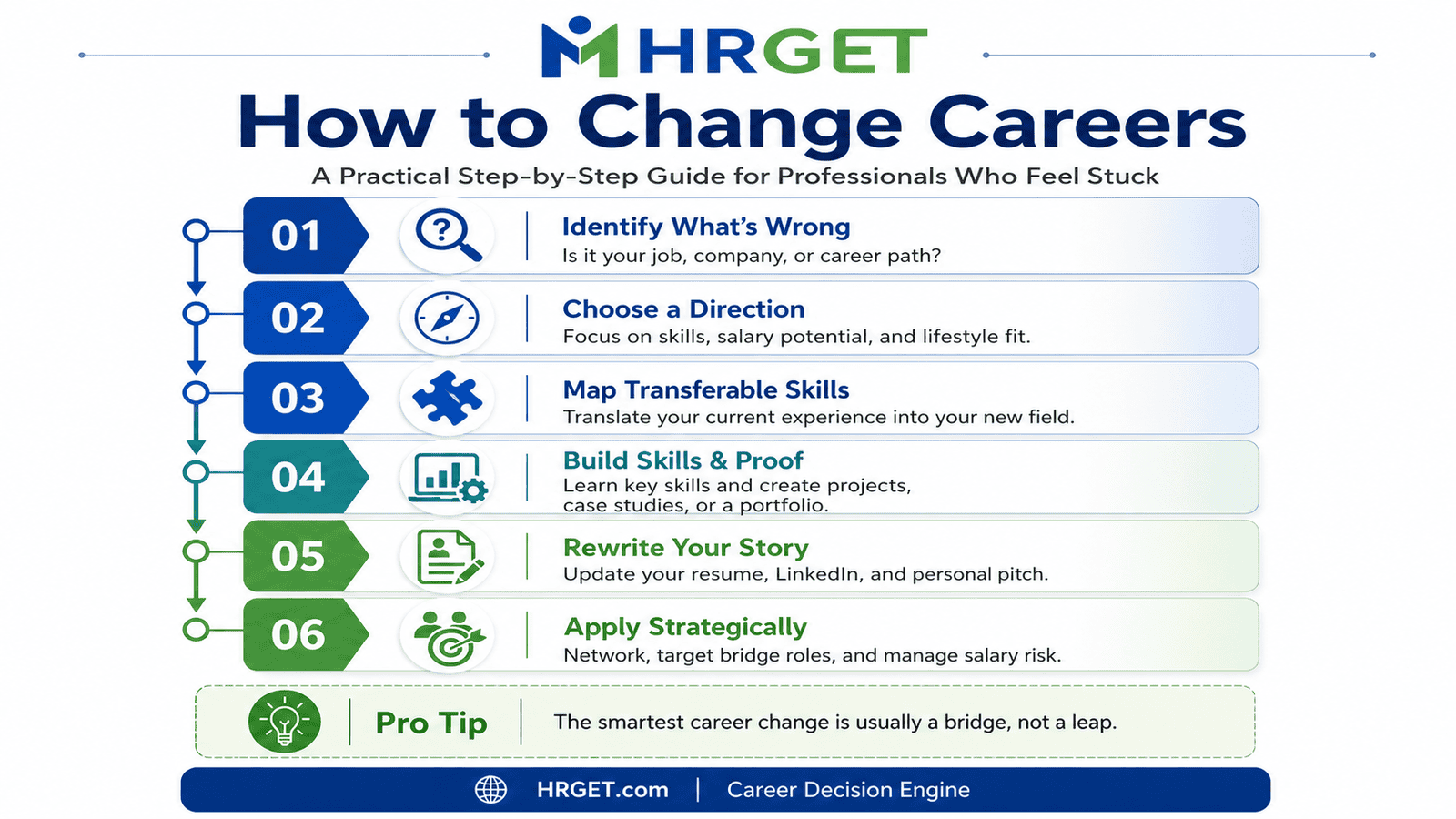
The 10-Step Career Change Plan
The following steps aren’t meant to be completed in a weekend. They’re a structured sequence designed to reduce risk, build momentum, and give you market feedback before you’ve committed to anything irreversible.
1
Diagnose the Real Problem
Before you change careers, get the diagnosis right. Is the issue your manager, your company, your role, or the career path itself? Moving to a new employer when the problem is the career wastes a year. Changing careers when the problem is just your boss wastes much more. Be honest with yourself about which layer is actually broken.
2
Separate a Career Change from a Job Change
A job change means taking a similar role somewhere else. A career change means changing the fundamental nature of the work you do. Conflating the two leads to poorly targeted searches and confusion in interviews. Define clearly which one you’re pursuing — it changes every subsequent step.
3
Choose a Direction Using Three Filters
Don’t pick a new career based on what looks appealing in LinkedIn posts. Every field has hidden friction. Run your target career through three filters before committing time to it: skill fit (does it leverage what you already do well?), market demand (is there real hiring activity and salary growth?), and lifestyle fit (does the day-to-day work style match how you want to live?).
4
Map Your Transferable Skills
You’re almost certainly not starting from zero. Communication, stakeholder management, data analysis, project coordination, process improvement, commercial judgment — these cross industries. The work is in translating your existing experience into the language and framing of the target field. Most career changers fail to do this translation, which is why hiring managers see them as beginners.
5
Research the New Career Like an Investor
Study at least 20 real job descriptions in your target field. Look for patterns in required skills, tools, seniority expectations, and salary bands. Then speak to 6–10 professionals actually doing that work. Ask them about the stressful parts, the things people misunderstand about the role, and what they’d learn first if starting today. Job descriptions and LinkedIn success stories are marketing material. Real conversations are market research.
6
Close Skill Gaps Without Quitting Too Early
Categorise your gaps into three buckets: must-have skills (required to get interviews), nice-to-have skills (improve competitiveness but aren’t blocking), and proof skills (demonstrate you can actually do the work). Prioritise in that order. A certificate from a six-week course tells a recruiter you studied something. A project tells them you can apply it. Build in that sequence.
7
Build Proof Before Applying
Hiring managers see career changers as risk. Your job is to reduce that perceived risk through tangible evidence of capability. Depending on your target field: product teardowns and user research summaries for PM roles; SQL dashboards using public datasets for data analytics; content strategy audits and sample campaign briefs for marketing. The specific form matters less than having something real to show and discuss in interviews.
8
Rewrite Your Resume and LinkedIn for the New Direction
Your old resume was built to get your old job. It will keep getting you your old job. Reposition your professional story so every line speaks to the target role. Don’t hide your background — reframe it. Emphasise the skills and outcomes that translate. Lead your LinkedIn headline with what you’re moving toward, not what you’re leaving behind.
9
Network for Insight First, Referrals Later
Most professionals network badly by immediately asking for a referral from someone they’ve just met. A better approach: reach out for a 10-minute conversation to understand what skills matter most and how professionals typically break in. After you’ve built proof, you can follow up and ask if they’d keep you in mind for relevant opportunities. People refer candidates they believe in — and belief is built through multiple interactions, not a single cold message.
10
Manage the Salary Drop, Risk, and Timing
A career change is not just an emotional decision — it’s a financial one. Before you move, calculate how many months of savings you have, whether a temporary salary cut is genuinely manageable, and what the five-year salary ceiling looks like in the new field. Don’t compare your current salary to your starting salary in the new career. Compare your likely trajectory in both fields at the three- and five-year mark. That’s the number that actually matters.
The Four Levels of Career Change
Not all career changes are created equal. The level of change you’re making determines the timeline, the risk, and the strategy required. Most professionals underestimate how much the level of transition matters.
| Level | Description | Example | Risk & Timeline |
|---|---|---|---|
| Level 1 | Same role, new employer | HR Manager → HR Manager at another company | Low risk · 1–3 months |
| Level 2 | Same field, new function | Recruiter → HR Business Partner | Low–moderate · 2–4 months |
| Level 3 | Adjacent field — skills overlap | Business Analyst → Product Manager | Moderate · 4–9 months |
| Level 4 | Completely new field | Lawyer → UX Designer | High · 9–18 months |
Pro Tip
The smartest first career change is rarely a 180-degree pivot. It’s a 30–60 degree turn into an adjacent field where your existing background still carries weight. Aim for Level 3 first. You can move to more distant fields once you’ve established yourself in the adjacent one — and you’ll do it from a position of credibility rather than a blank slate.
How to Map and Translate Your Transferable Skills
The biggest error career changers make isn’t failing to acquire new skills. It’s failing to translate the skills they already have into the language of the new field. You almost certainly have more relevant experience than you think — but presenting it in the wrong frame makes it invisible to recruiters.
Transferable skills that carry value across most professional roles include: communication, stakeholder management, data analysis, project coordination, problem-solving, writing, research, negotiation, process improvement, commercial judgment, and team leadership. The key is reframing how you describe them.
Three translation examples that work in practice:
Teacher → Corporate Learning & Development: Don’t say “I taught students.” Say “Designed structured learning programmes, simplified complex concepts for diverse audiences, assessed comprehension through measurable outcomes, and adapted delivery based on individual performance gaps.” That’s L&D language — not classroom language.
Sales → Customer Success: Don’t say “I handled sales calls.” Say “Managed client relationships through onboarding and post-sale phases, identified expansion opportunities, resolved concerns before they became churn risks, and maintained revenue retention across a portfolio of accounts.” CS managers will see that immediately.
Software Engineer → Product Manager: Don’t say “I wrote code.” Say “Built user-facing features under time and resource constraints, worked cross-functionally with design and QA, evaluated technical trade-offs, and delivered product increments aligned to user feedback.” That’s PM framing of engineering experience.
The translation isn’t dishonest. It’s just competent positioning. The experience is real. The language needs to match the audience reading it.
Real Scenario: Operations Manager to Product Management
Real Scenario
A 32-year-old operations manager at a mid-size logistics company has spent five years managing reporting cycles, escalation processes, and cross-functional coordination. The salary is decent — around £52,000 in the UK or $78,000 in the US — but the work feels repetitive and strategically thin. She becomes interested in product management after noticing that the PMs at her company seem to have more autonomy and business influence. Here’s the impulsive approach versus the smart one.
The impulsive approach: She quits in frustration, signs up for a 12-week PM bootcamp, adds “Aspiring Product Manager” to her LinkedIn, and begins applying to PM roles at tech companies. After four months of mostly silence, she accepts an unrelated operations role just to pay rent — and feels worse than before.
The strategic approach: She stays employed while studying 25 PM job descriptions. She speaks to eight product managers over six weeks, spending 15–20 minutes each asking about the real nature of the work. She discovers that operations-heavy PM roles (product operations, programme management, internal tools) are actively recruiting people with exactly her background. She builds two product teardown documents using her knowledge of logistics workflows, volunteers to lead a process automation scoping project at her current company, and repositions her resume to emphasise cross-functional execution, problem diagnosis, and stakeholder alignment. Four months later she’s interviewing for a product operations manager role that pays more than her current job and has a clear path to a full product manager title within 18 months.
The difference isn’t talent. It’s the quality of the strategy — and the patience to build credibility before applying.
Your 30-60-90 Day Career Transition Plan
Career change doesn’t require a dramatic single decision. It requires consistent action over a defined window. Here’s how to structure the first 90 days.
Days 1–30: Diagnose and Research
- Identify precisely what’s wrong — job, company, or career
- Shortlist 2–3 realistic career directions based on your skills
- Study at least 20 job descriptions per target field
- Conduct informational conversations with 4–6 professionals
- Compare salary trajectories and lifestyle realities honestly
- Eliminate options that don’t survive scrutiny
Days 31–60: Build Credibility
- Learn the 2–3 must-have skills identified in JD research
- Build one or two proof projects specific to the target role
- Rewrite your LinkedIn headline and summary for the new direction
- Draft a career-change resume summary that connects your background to the target
- Join relevant professional communities — Slack groups, local meetups, LinkedIn groups
Days 61–90: Test the Market
- Apply to 15–20 targeted roles in bridge and adjacent positions
- Continue outreach to professionals in the target field
- Request specific feedback on your resume and positioning from people in the field
- Track interview response rates — they tell you whether your positioning is landing
- Explore internal transfer options at your current employer
- Adjust your positioning based on what the market is actually responding to
By day 90, you should have a clear signal: is this path realistic as positioned, does it need adjustment, or does it require more runway of preparation? That feedback is worth more than months of research in isolation.
Best Career Transitions by Starting Background
There’s no universal “best career to switch into.” The best transition depends on what you’re bringing to the table. Here are realistic, well-worn paths by starting point — not based on what’s trending, but on where career changers have actually found credible entry points.
| Your Background | Strong Adjacent Transitions | Why It Works |
|---|---|---|
| HR & Recruiting | People Analytics, HR Tech Implementation, Employee Experience, L&D | Deep people and process knowledge translates directly |
| Sales | Customer Success, Revenue Operations, Partnerships, Product Marketing | Commercial relationships and pipeline thinking are highly portable |
| Teaching / Education | Corporate Training, Instructional Design, EdTech CS, Curriculum Development | Pedagogical design skills map directly to L&D and content roles |
| Software Engineering | Product Management, Technical Programme Management, Solutions Architecture | Technical credibility makes PM transitions highly credible |
| Finance / Accounting | Data Analytics, FP&A, Pricing Strategy, Revenue Operations | Numerical rigour and business model literacy transfer cleanly |
| Operations | Programme Management, Product Operations, Process Consulting, Supply Chain Analytics | Execution and systems thinking are perennially undervalued in new roles |
| Law | Compliance, Risk Management, Legal Tech, Policy, Business Strategy | Analytical rigour and documentation standards are immediately transferable |
Notice the pattern: the easiest transitions tend to move into roles that use the same cognitive skills in a different context, rather than requiring an entirely new skill set from scratch.
Common Career Change Mistakes That Set People Back by Years
Quitting before testing the new career. Frustration with your current role is not evidence that the new one is better. Test it first — through conversations, freelance work, internal projects, volunteer roles, or job shadowing. Quitting without validation is the fastest route to lateral suffering, not improvement.
Choosing based on hype. Every few years a field captures the cultural imagination: coding bootcamps in 2016, data science in 2019, AI in 2023-24. Hype doesn’t mean fit. Product management, for example, is perpetually glamorised online and genuinely miserable for people who hate ambiguity, stakeholder politics, and outcomes without direct control. Know the day-to-day reality before you romanticise the title.
Collecting courses instead of building proof. Courses can become a form of productive procrastination. They feel like progress but don’t reduce a hiring manager’s risk perception the way a real project does. At some point — usually after one or two foundational courses — you need to start building and applying, not studying further.
Ignoring salary reality. Passion is important. So are your rent, mortgage, and family commitments. Research the entry-level, mid-level, and senior salary bands in the new field before making any irreversible moves. The question isn’t just whether you can afford to take a pay cut now — it’s whether the new career’s five-year ceiling is actually higher than your current path.
Warning
The most dangerous career change scenario is changing role, industry, seniority level, country, and work style simultaneously. Every extra variable you change multiplies the risk and the timeline. Sequence the transition where possible: same industry, new function — then new industry once established, or vice versa. Complexity is the enemy of successful execution.
Applying with a generic resume. A resume written for your old career will keep landing you interviews for your old career. Hiring managers don’t connect the dots for you. Your resume must explicitly bridge your past experience to the target role — with a reframed summary, selectively emphasised bullet points, and clear evidence of preparation for the new field.
The Career Change Mindset That Actually Works
Most professionals stay stuck because they’re waiting for certainty before acting. But career clarity almost always comes from action, not before it. You don’t need a perfectly mapped 10-year plan. You don’t need to quit your job tomorrow. You don’t need to start from zero.
What you need is a structured experiment: one clear direction, serious research, real conversations with people in the field, one or two pieces of tangible proof, and a targeted test of the market. That’s how people who successfully learn how to change careers actually do it — not through a single dramatic decision, but through a series of deliberate, reversible steps that reduce risk while building forward momentum.
The goal isn’t to make the perfect move. The goal is to make a better move — with your eyes open, your finances protected, and your positioning genuinely competitive.
Verdict
Career change works when it’s treated as a strategy problem, not an emotional escape. Diagnose accurately. Choose adjacently. Build proof before you apply. Test while employed. The professionals who manage this well don’t just get new jobs — they get careers that actually fit.
FAQ: How to Change Careers
How do I know if I should change careers or just change jobs?
If you still enjoy the type of work but dislike your manager, company culture, or compensation, you likely only need a job change. If the work itself drains you — and the prospect of a senior role in your field doesn’t excite you — a career change is probably the right call. The cleanest test: would a promotion in your current field energise you or fill you with dread?
Is it too late to change careers at 30, 35, or 40?
No. But the approach changes with age and financial commitments. In your 30s and 40s, the smartest moves involve bridge roles, internal transfers, part-time testing, and savings planning rather than sudden jumps. At 35, you can still build a strong second-act career with 25+ working years ahead of you — the key is reducing unnecessary risk while making the move.
Should I quit my job before changing careers?
Usually no. Research, skill-building, and proof creation can all happen while employed. Quitting makes sense only when your current role is seriously damaging your health or when you have 9–12 months of savings and a clear, validated transition plan. Jumping without a financial runway dramatically increases the pressure to accept the wrong next role.
How long does a career change typically take?
A realistic career change takes 3 to 18 months depending on the distance between your current role and the target. Adjacent moves — say, an operations manager pivoting into programme management — can happen in 3–6 months. A completely new field requiring new technical skills and a portfolio can realistically take 12–18 months of deliberate preparation.
How do I change careers with no experience in the new field?
Create evidence of ability rather than waiting for experience to arrive. Build projects, volunteer for adjacent work internally, take on freelance engagements, publish case studies, or complete practical certifications with real deliverables. Hiring managers respond to proof of capability. Saying you’re interested is not enough — showing that you can do the work is what converts interviews into offers.
How do I explain a career change in interviews?
Lead with a forward-looking narrative, not an escape story. Explain what you learned and contributed in your previous career, why the new field represents a natural next step for your skills, what preparation you’ve completed, and how your background makes you an unusual hire — in a good way. Interviewers forgive a non-linear path when the candidate sounds deliberate and prepared.
Should I accept an entry-level role when changing careers?
Not automatically. Look first for bridge roles where your prior experience still counts but the function shifts toward your target. If you must accept a junior title, treat it as a 12–18 month investment with a defined exit to the mid-level. Ensure the new field has strong growth potential and a realistic salary recovery path within two to three years.
What are the best careers to switch into in 2026?
Fields with consistent demand include data analytics, product management, cybersecurity, customer success, HR technology, programme management, and UX research. However, the best career to switch into is one that matches your existing skills, supports your salary needs, and fits your preferred work style. Trending fields are only valuable if your profile is genuinely competitive in them.
Once you’ve made the move, your next challenge is accelerating within the new role.
How to Get Promoted Faster → Read the Guide

Jonathan Reed: Executive Career Strategist & Leadership Advisor | Former Partner, McKinsey & Company | Executive Coach to Amazon & Unilever Leaders | 18+ Years in Career Strategy
Jonathan Reed spent nearly two decades as a Partner at McKinsey & Company, where he advised organisations on leadership development, talent strategy, and organisational design across the US, UK, and Asia. Since leaving consulting, he has worked as an executive coach to senior leaders at Amazon, Unilever, and a clutch of high-growth scale-ups — helping them navigate promotions, career pivots, and the unwritten rules of visibility and influence at the top. Based between London and New York, Jonathan writes for HRGet.com to give working professionals an honest look at how careers actually scale — and why so many talented people stall without ever knowing why.


Pingback: Step by Step Career Advancement: Your 2026 Roadmap